
Alexander County reports 58% proficiency; district near top of Northwest region
Get AI-powered insights, summaries, and transcripts
Subscribe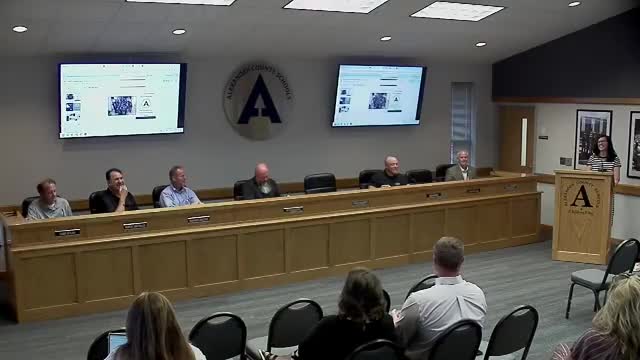
Summary
Dr. Amy Bowles presented state testing results showing 58% overall proficiency for the 2024-25 school year, with two schools exceeding growth and several schools moving up letter grades; district leaders outlined follow-up supports and targets for low-performing subgroups.
Dr. Amy Bowles, executive director of curriculum and instruction for Alexander County Schools, told the school board that the district posted 58% overall proficiency on the state testing report for the 2024-25 school year and ranked third in the state’s Northwest Region, about 3 percentage points above the state average. The district’s result, she said, places it “above where a lot of their peers are performing in the area.”
The testing report, Bowles said, separates results into grade-level proficiency (GLP, level 3 and above) and college- and career-readiness (CCR, level 4 and above). Bowles said the district’s report includes EOG and EOC results plus ACT, WorkKeys and English-learner progress metrics. “When we talk about proficiency, we are looking at the full expectation of where they expect them to be college and career ready at the end of the year,” she said.
Bowles told the board two schools exceeded growth under the state growth-index methodology run through EVAAS (reported as EVOS in the presentation): Alexander Early College and West Alexander Middle School. She said six schools met growth and three did not meet growth; two of the three showed year-over-year improvement in their growth index. The district also reported that three schools carry federal TSI-AT (additional support) designations for the subgroup of students with disabilities and that one school, Wittenberg, exited a federal TSI designation after improving its performance.
Bowles cautioned that science scores were lower this year because the state implemented new science standards and a new assessment, which she said typically produces a first-year decline while the new assessment is renormed. She said the district expects gains in the second year of implementation.
District leaders reported no schools in the state’s CSI (Comprehensive Support and Improvement, typically the bottom 5% of Title I schools) category. Bowles also said ACT and WorkKeys indicators remain above the state average, and the district’s graduation rate is rising but remains below the state rate.
Superintendent Bill Griffin commended the curriculum team and said the district will use the testing data to both celebrate gains and target supports for schools and subgroups that remain below targets. Griffin repeated his longtime statement that he does not want any low-performing schools in the county and said the district will use its new strategic plan and instructional framework to focus interventions.
Board members asked for comparisons to national standards. Bowles noted that the national measure used for comparisons is NAEP (National Assessment of Educational Progress) and that NAEP measures are not directly comparable to the state tests; she said NAEP national averages are in the thirties while the district’s reported proficiency is 58%, and she offered to follow up with more detailed national comparisons.
The presentation materials and the state testing report are available through the North Carolina Department of Public Instruction, Bowles said, and she offered to provide additional district-level breakdowns on request.