
Blue Ridge Health District warns federal grant cuts threaten core public-health services
Get AI-powered insights, summaries, and transcripts
Subscribe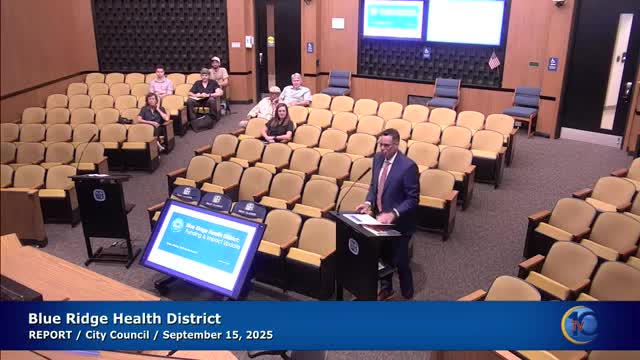
Summary
A Blue Ridge Health District representative told the Charlottesville City Council that recent and proposed federal funding cuts have already reduced local capacity and could force furloughs or service reductions if grants are not restored.
A Blue Ridge Health District representative told the Charlottesville City Council on Sept. 15 that the district is facing sudden and uncertain federal funding changes that have reduced staffing and put core public-health services at risk. The representative said federal grants supporting COVID-era work and long-standing preparedness programs have been cut or placed in limbo, and that local consequences include staff losses and reduced outreach: “we have a lot more questions than we actually have answers to at this point,” the presenter said. The presenter said the district serves six localities and that grant funding for the current fiscal year is “right around $1,800,000,” with the Women, Infants, and Children (WIC) program at roughly $738,000 and the Public Health Emergency Preparedness (PHEP) grant at about $260,000. The district reported losing about $2.9 million in COVID-related federal funding that had previously been extended through June 2027; the cuts resulted in the elimination of about 15 positions, the presenter said. Those positions included community health workers who held office hours linking residents to mammograms, rental-assistance programs and job connections. Without that capacity, the district said it has offered fewer office hours and has had to rely on regional epidemiology staff to investigate outbreaks in congregate settings. The district also highlighted cuts or uncertainty in other federal programs that underpin local services, including the Ryan White program (HIV services) and pharmaceutical rebate funding. The presenter said the district absorbed a roughly $5,600 loss related to disease-intervention staffing into its cooperative (non-grant) budget to maintain STI-contact-tracing services. On emergency preparedness, the presenter said national cuts of up to $385 million could translate to about $260,000 locally, a reduction that would affect the district’s ability to respond to outbreaks, school-based TB screenings and other investigations. The district reported that other community providers have stopped offering TB screening, increasing local demand for public-health clinics. The district said fiscal planning is underway: it will seek to move some grant-funded positions to more stable funding sources, coordinate with local governments on budget requests to the state, and refine budget asks that will be submitted in October. The presenter noted that local governments previously contributed to stabilizing positions when grants ran short. Councilors asked about the possibility of a federal-government shutdown. The presenter said the district was building contingency plans and could maintain some services for a limited period by using cooperative-budget funds, but that prolonged gaps could require furloughs. No formal council action was taken during the presentation. The health district asked for continued coordination with localities and said it would provide budget requests and additional information during the fall budget cycle. Taper: The representative closed by urging continued partnership across local health providers and city government to protect core public-health services while federal funding uncertainty continues.