
Charlottesville Free Clinic reports expanded dental services, warns of rising patient demand
Get AI-powered insights, summaries, and transcripts
Subscribe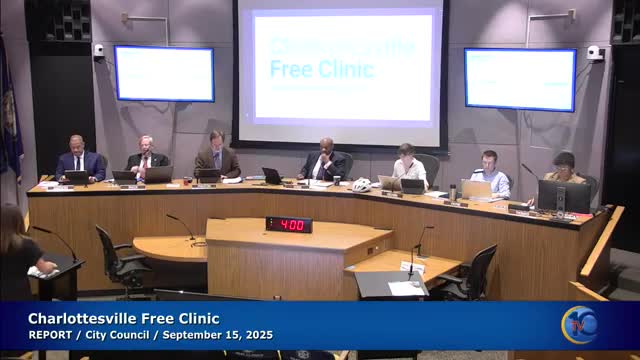
Summary
At a Sept. 15 Charlottesville City Council meeting, the Charlottesville Free Clinic outlined growth in dental and specialty services, volunteer capacity, and pharmacy savings while cautioning that rising uninsured rates could increase demand this winter.
Willa Barnhart, executive director of the Charlottesville Free Clinic, told the Charlottesville City Council on Sept. 15 that the nonprofit has expanded dental capacity and added specialty services while preparing for a likely increase in people seeking care. The clinic, which Barnhart described as “a non profit health care organization. We serve the working uninsured and under insured members of our community,” has opened a new dental clinic and broadened medical services to reach more patients, she said. Barnhart said the dental clinic now has six treatment rooms, up from four, and the organization amended dental eligibility so medical and dental patients can access care more easily. She described a recent move into digital dentistry after the clinic received a 3-D printer and a partnership with a company called Dandy that lowered lab rates so the clinic could begin offering crowns and partial dentures for free or reduced cost. Clinic highlights and why they matter: expanding dental capacity addresses urgent oral-health needs tied to employment and general health; in-house specialty services (physical therapy and optometry) and mental-health screening attempt to reduce referrals and out-of-pocket costs for low-income patients. Barnhart said the clinic provided just over 9,000 visits across medical and dental services last year and that volunteers remain central to operations. “We had 972 volunteer roles that were filled by 754 people last year,” she said, adding that about 154 volunteer physicians come from Sentara and the University of Virginia after daytime shifts. On pharmacy and cost savings, Barnhart said the clinic uses prescription assistance programs to secure steep discounts from drug manufacturers. She reported monthly savings in the range of about $100,000 to $160,000 via those assistance programs, which reduces medication costs for patients and the clinic. Barnhart also described new and expanded services: two volunteer physical therapists (with a potential third), an optometry room staffed monthly by volunteers who help secure discounted glasses, and mental-health screening using the PHQ-9 at intakes and at six-month follow-ups. She said the clinic logged roughly 840 mental-health visits last year. The clinic relies primarily on private donations and local support rather than federal grants. Barnhart said more than 60 percent of funding currently comes from individuals and that the organization receives significant support from the city of Charlottesville and state-level funding through the Virginia Association of Free and Charitable Clinics. On future demand, Barnhart warned the clinic is preparing for an increase in uninsured and underinsured patients if health-plan deductibles and other costs rise. “ACA with deductibles going up and people not being able to afford their health insurance, that will significantly, probably grow our patient base starting in January,” she said. Councilors asked about volunteer qualifications and federal funding. Barnhart said clinical volunteers are typically licensed clinicians (doctors, dentists, hygienists) while nonclinical roles are open to community volunteers. She said the clinic does not receive direct federal funding and that recent donor conversations suggest giving has slowed. The clinic did not present an action item requiring council approval. The presentation provides context for future budget and partner discussions and signals potential increases in service demand that could intersect with local planning. Taper: Barnhart answered additional council questions about staffing, volunteer recruitment and how the clinic coordinates referrals to UVA Health and other partners; she said the clinic is monitoring demand and will adjust services if necessary.