
Free clinic reports rising visits, expands dental and pharmacy services amid staffing and funding worries
Get AI-powered insights, summaries, and transcripts
Subscribe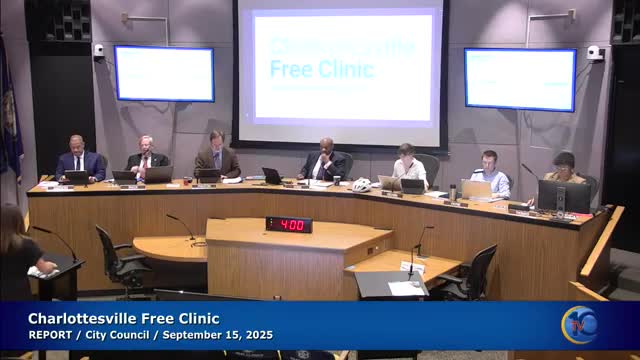
Summary
The Charlottesville Free Clinic told City Council it expanded dental capacity and specialty services and served roughly 9,000 visits last year, while leaders warned about rising demand if insurance affordability worsens and noted reliance on volunteers and local support.
The Charlottesville Free Clinic reported to the Charlottesville City Council on Sept. 15, 2025, that it has expanded dental capacity and specialty services while continuing to serve the working uninsured and underinsured in Charlottesville and Albemarle County. The clinic said it provided just over 9,000 visits between its medical and dental clinics in the last year and expects demand to grow if insurance affordability worsens. The clinic’s executive director said the organization’s work fills gaps in local health care access. Willa Barnhart, executive director of the Charlottesville Free Clinic, told councilors the clinic’s recent strategic goal was to increase patient volume and integrate medical and dental services. Barnhart said the clinic built a new dental suite that increased treatment rooms from four to six and eased patient navigation between medical and dental care. She said the clinic now has one staff family nurse practitioner in the medical clinic and one dentist in dental services, and that volunteers supplement clinical capacity: last year the clinic filled 972 volunteer roles with 754 people, including 154 doctors who typically come from Sentara and UVA. Barnhart outlined service additions and counts: the clinic has started offering on-site physical therapy with two volunteers (seeking a third), optometry on a monthly donated schedule, and more mental-health visits—about 840 last year—provided in part by a family nurse practitioner who also counsels and by a volunteer from the Women’s Health Initiative. The clinic screens new patients with the PHQ‑9 depression questionnaire and repeats it every six months. On dental advances, Barnhart said the clinic acquired 3D-printing equipment through a donation and has produced roughly 75 occlusal (night) guards since June, 14 removable partial dentures and completed its first crown in partnership with a third-party digital dentistry firm, Dandy, at reduced rates. She said the dental expansion helped recruit a new hygienist and VCU dental students and hygiene students who volunteer regularly. Barnhart described the pharmacy program as a major savings channel, saying the clinic’s prescription assistance efforts and a change in software have improved volunteer workflow; she reported estimated savings “about $100,000 to $160,000 every month” through manufacturer prescription assistance programs. The clinic also pays for certain specialty referrals (for example, radiology and gastroenterology) at discounted rates, which the clinic estimated at roughly $60,000 to $80,000 annually. Councilors asked about funding risks and volunteer recruitment. Councilor Michael (Charlottesville City Council) asked whether federal changes to Medicaid or the Affordable Care Act would directly affect the clinic’s budget; Barnhart said the clinic does not receive federal funding but could see downstream demand increases and has begun hearing from donors who are giving less. Councilor Natalie (Charlottesville City Council) asked about volunteer qualifications; Barnhart said clinical volunteers are generally doctors, dentists, nurses or health professionals, and nonclinical roles (front desk, pharmacy assistance) are open to the broader community. Barnhart told councilors the clinic is "bracing" for higher patient numbers beginning in January if insurance affordability declines; she said the organization will monitor demand and adjust operations as needed but made no staffing or budgetary commitments at the meeting. The presentation closed with councilors thanking clinic staff and volunteers and noting the clinic’s role in the local health safety net.