
CalPERS committee hears four audit firms emphasize continuity, specialist access and new audit technology
Get AI-powered insights, summaries, and transcripts
Subscribe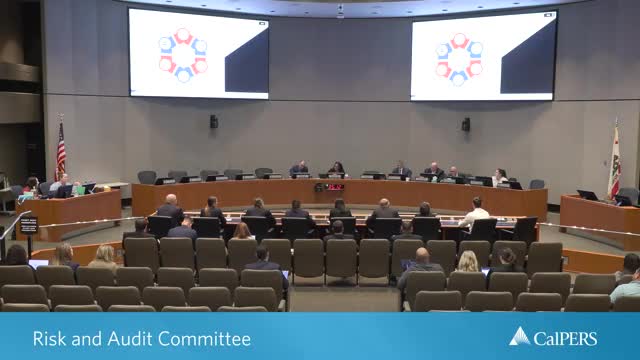
Summary
Representatives from BDO, Crowe, KPMG and Plante Moran each presented to the CalPERS Risk & Audit Committee, stressing long‑term experience with public pension audits, access to specialists and technology to streamline testing and address complex investments, actuarial assumptions and census data.
Members of the CalPERS Risk & Audit Committee interviewed four finalist audit firms Tuesday, hearing each firm lay out its team, audit approach, and tools for testing complex investment portfolios, actuarial valuations and member census data. The firms — BDO, Crowe, KPMG and Plante Moran — emphasized continuity of staffing, specialist access (including actuaries and investment valuation experts) and increased use of data analytics and machine‑assisted review to improve efficiency.
The presentations opened with BDO, whose executive sponsor Steven Shill said the firm has served CalPERS for six years and highlighted continuity across key engagement leaders. BDO partners described proprietary pricing and machine‑reading tools and said the firm became an employee stock ownership plan (ESOP) in 2023. Crowe told the committee it audits two of the next four largest U.S. public pensions, and highlighted a centralized alternative‑investment team that audits more than 1,000 private funds annually. KPMG emphasized experience with more than a dozen large public pensions and a platform it calls KPMG Clara that the firm said supports population‑level analytics. Plante Moran described a people‑focused firm culture and said it pools internal specialists and actuarial experts for complex valuation and OPEB work.
Across firms, committee members pressed on four recurring subjects: (1) how each firm samples and tests active member census data for PERF B and C; (2) how each firm evaluates actuarial experience studies and related assumptions that affect liabilities and disclosures; (3) how each firm will test investment valuations and disclose investment fees; and (4) how each firm will manage the schedule and report risks that could delay timely completion of the audit. Firms described risk‑based sampling, rotating employer testing for cost‑sharing plans, using custodial confirmations and manager confirmations for existence and valuation testing, and employing portals/dashboards for project management and document exchange.
The interviews were question‑driven rather than decision sessions; no formal committee action or vote occurred during the presentations. Committee members noted concerns about transparency of private‑market fees and the timeliness of audits, prompting firms to describe options for deeper fee reviews, enhanced analytics and shared dashboards to surface exceptions earlier in the audit process.
The interviews concluded with the committee thanking the firms; no procurement decision was made on the record during the session.