Auditors describe risk‑based approaches for member census testing and actuarial reviews
September 16, 2025 | California Public Employees Retirement System, Agencies under Office of the Governor, Executive, California
This article was created by AI summarizing key points discussed. AI makes mistakes, so for full details and context, please refer to the video of the full meeting. Please report any errors so we can fix them. Report an error »
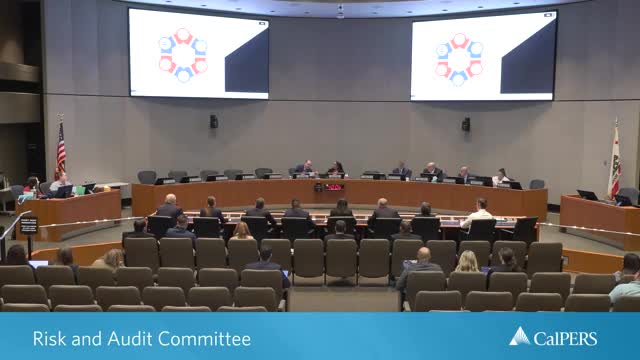
Crowe described following AICPA guidance developed for pension audits and said it had members who helped draft relevant sections of the audit guide; the firm said it would use a sample of contributing employers with rotational selection and rely on secure electronic submissions for employer census data. KPMG illustrated a population‑level comparison engine that flags exceptions such as birth‑date changes, removed members or social‑security inconsistencies; the firm said it routinely compares whole populations rather than relying only on small random samples. BDO emphasized walkthroughs of internal controls and a risk assessment to select targeted procedures and said it is developing proprietary census‑analytics tools. Plante Moran said auditors should pair control testing with substantive testing at employer sites and that deep internal‑control reviews can produce operational benefits.
On actuarial experience studies, multiple firms said their actuaries would evaluate whether management’s assumption sets are reasonable and consistent with actuarial standards of practice. Plant Moran’s lead actuary, Ben Johnson, told the committee his review would examine demographic and economic assumptions (mortality, discount rate, salary scale, COLA) for their credibility and how CalPERS’ assumed experience compares with observed trends; he noted actuaries must weigh recent exceptional events (for example, pandemic effects) in credibility calculations. Several firms offered to run parallel modeling or sensitivity analyses when an assumption change could materially affect the financial statements.
Why it matters: Census accuracy and actuarial assumptions drive pension liabilities and contribution rates. Committee members stressed the need for both thorough testing and efficient processes for thousands of employers and millions of participants.
Next steps: Firms said they would design audits to reflect AICPA guidance and GASB requirements, use secure portals for employer data, and engage actuaries early in the audit planning process to avoid late‑stage adjustments.
View the Full Meeting & All Its Details
This article offers just a summary. Unlock complete video, transcripts, and insights as a Founder Member.
30-day money-back guarantee
Sponsors
Proudly supported by sponsors who keep California articles free in 2026

