
Clayton unveils interactive FY 2026 budget book to boost transparency
Get AI-powered insights, summaries, and transcripts
Subscribe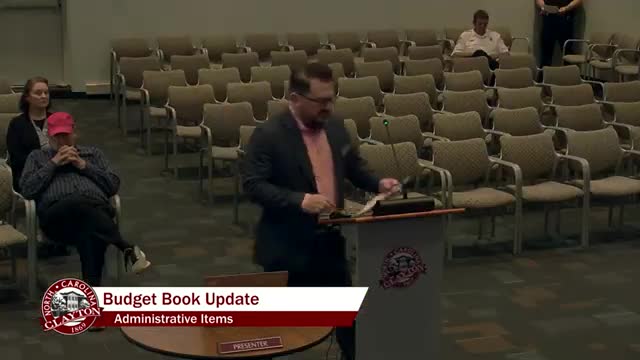
Summary
Budget Manager Todd Millen demonstrated a new ClearGov-hosted, interactive FY 2026 budget book at the Town Council meeting, giving residents web access to departmental finances, revenue and expenditure breakdowns, CIP projects and a glossary of municipal budgeting terms.
At the Clayton Town Council meeting, Budget Manager Todd Millen demonstrated the town's new interactive fiscal year 2026 budget book, launched on the ClearGov platform to give residents on-demand access to department budgets, revenue sources and capital‑project information. The presentation included examples of how the tool displays revenues and expenditures, department goals and fund definitions and showed the town's plan to more closely align next year’s budget with the strategic plan.
The budget book replaces a static PDF and embeds interactive charts, department pages and a glossary so residents can view the same information available to council. Millen said, “So the reason I think this matters is that it's it's most certainly increasing transparency, and that's been a goal from day 1.” He walked council through features including an embedded “budget in brief,” a table of contents that stays clickable while browsing, fund‑level schedules, departmental FTE counts and links to statutory guidance.
Why it matters: the tool centralizes information the town says residents have asked for — definitions of funds, 10‑year revenue and expenditure histories, debt schedules and the capital improvement plan (CIP). Millen pointed out that property taxes make up about 40% of the town's revenues in the FY26 budget, while public safety (police and fire) is about 23% of expenses and public works about 21%. He also noted the town budget now shows 350 budgeted positions for FY26 and seven new positions added in the adopted budget.
Supporting details: the previous budget document was a roughly 102‑page PDF; the ClearGov platform lets users generate a new PDF from selected sections (ClearGov will email a link and, for the full book, the process can take about 10 minutes). Millen said the site includes fund explanations and links to North Carolina statutes that govern budgeting, and he identified N.C. General Statutes as the legal basis for adopting an appropriated, balanced budget.
Council members and staff praised the work. The presentation team included Jessica Watkins, an intern Millen credited with substantial copy work, and the communications department, which helped publish the site. The town manager said the transparency module on the same vendor platform will come online later. Millen said staff will explore adding a contact or “ask a question” link on the website so residents can request clarification.
Discussion versus decision: Millen’s presentation was an informational staff report; council did not take formal action on the budget book at the meeting. The council earlier adopted the FY26 budget in June (as Millen noted), and the meeting discussion focused on public access, website functions and next steps for integrating the strategic plan with the budget.
Ending: The budget book is published to the town website for public browsing; staff said they will follow up with a way for residents to ask questions and plan to integrate performance data and a budget calendar into the platform in coming months.