
Larimer County commissioners defend ending print edition of senior resource guide amid accessibility concerns
Get AI-powered insights, summaries, and transcripts
Subscribe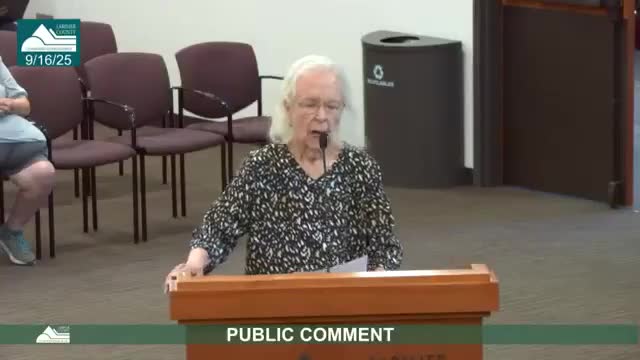
Summary
A public commenter urged the county to restore a printed senior resource guide; commissioners said rising printing and delivery costs and faster online updates drove the shift and said staff will try to help residents without reliable internet access.
Margaret Long, a Larimer County resident, urged the Board of County Commissioners on Sept. 16 to reconsider the county’s decision to stop printing its senior resource guide, saying many older adults cannot reliably use online-only resources. “Please consider carefully the decision to stop publishing the answers on aging,” Long said during the meeting’s public comment period.
The county’s commissioners acknowledged the concern but said the move away from a printed booklet was driven by rising costs and accessibility features available online. Commissioner Jody Shattuck McNally said the county faces sharply higher printing and delivery expenses and noted, “It's up over $50,000.” She added, “Trust me when I say, this is a hard decision to make,” and described the county’s shift to QR codes, multiple languages, and screen-reader–friendly formats.
Why it matters: Local seniors and caregivers rely on the guide for contacts and services; removing a printed edition can make it harder for residents without internet access to find help. County leaders said they weighed the trade-offs between printing costs and funding direct services such as in‑home supports.
County officials described mitigation steps. Shattuck McNally and other commissioners said staff plan to keep the guide available online, provide printable sections on request, and explore ways for caregivers and community partners to print or distribute material for residents who need it. Commissioner John Kefalas said staff will provide an updated resource guide and encouraged human services staff to hear from elders who cannot access online information.
Discussion versus decision: Commissioners said the printed edition had been discontinued as part of budget and delivery considerations; no new ordinance or formal vote changing that policy occurred at the Sept. 16 meeting. The commissioners repeatedly invited residents who lack internet access to notify human services so staff can evaluate additional assistance.
What remains unclear: The county did not set a timeline for additional printed distribution (beyond ad hoc printing of sections) or provide a specific program to guarantee hard copies to all seniors who request them. The meeting record shows an offer by commissioners to meet individually with affected residents to identify solutions.
Local reaction: Long described trying to use a smartphone to reach resources and becoming discouraged; she said a printed booklet would be easier to annotate and keep. Commissioners thanked Long for raising the issue and offered to follow up.
The board did not take further formal action on the matter at the meeting; commissioners said they would continue conversations with human services staff about access and distribution options.