
State and local watershed councils say stakeholder forums are functioning but need funding for wildfire mitigation
Get AI-powered insights, summaries, and transcripts
Subscribe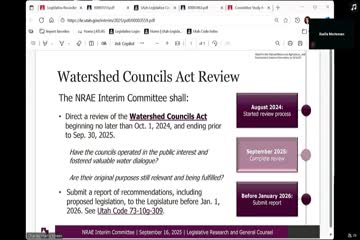
Summary
Utah watershed council leaders told the committee the Watershed Councils Act has established stakeholder forums across 11 watershed areas and a state council; councils recommend increased funding and coordination with U.S. Forest Service for wildfire mitigation and post‑fire rehab.
Utah’s watershed councils have grown into regular stakeholder forums since the Watershed Councils Act (HB 166, 2020) established local councils across 11 watershed units and a state council, officials told the Natural Resources, Agriculture and Environment Interim Committee.
Candace Hosneiger, director of the Utah Division of Water Resources, said the councils provide “regular and robust forums for stakeholder involvement” and have been used to gather local perspectives for the state water plan. Scott Paxman, chair of the Utah Watershed Council and general manager of the Weber Basin Water Conservancy District, said local councils typically include about 20 stakeholders and send representatives to the state council, which meets quarterly.
Council leaders urged additional investment to accelerate post‑fire mitigation and to increase coordination with the U.S. Forest Service under shared stewardship programs. “We’d like to get on top of these wildfire mitigations quicker and with more manpower and more funding,” Paxman said, noting current treatment parcels are small relative to need.
Committee members asked how councils are functioning. Leaders said councils initially faced startup challenges getting broad participation but have matured: “Once they met a time or 2 or 3, it’s really made a big difference,” Hosneiger said. The committee was briefed that the councils provide a channel for state agencies to present to local stakeholders and to collect basin‑level concerns for legislative and executive consideration.
No formal committee action was taken; staff noted the committee must submit a statutory report on the act by the end of the year and the council’s inputs will inform that report.