Get Full Government Meeting Transcripts, Videos, & Alerts Forever!
Get email alerts on the Zoning Childcare topic
No spam. Unsubscribe anytime.
Planning commission recommends child-care zoning amendments, restores D‑1 special‑use option
Summary
The Coldwater Planning Commission voted to recommend amendments to the city zoning ordinance to treat certain group child‑care homes in D‑1 as a special use and to allow child‑care centers in the AA district as a special use, advancing the measure to city council.
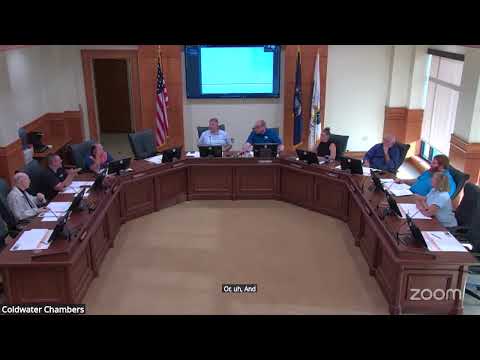
At a meeting of the Coldwater Planning Commission, members voted to recommend to city council amendments to the zoning ordinance that would (1) treat group child‑care homes in the D‑1 district as a special use and (2) allow child‑care centers in the AA district as a special use subject to additional standards. The recommendation passed by voice vote after discussion and public comment.
The changes were discussed during a public hearing on the proposed child‑care amendment. Mallory Van Wagner, a resident who identified her address at 293 North Fisk Street, asked for clarification about language that had removed certain child‑care uses from the D‑1 district. "I just wanted to clarify why that was done and if we could just have some conversations so I could give them a better understanding of why that decision was made or why it could not be a special use in the future," Van Wagner said.
Planning staff and commissioners discussed two specific amendments. Staff described that the current draft would strike group child‑care homes from the D‑1 district listing but would keep child‑care centers subject to special‑use review in both D‑1 and D‑2. Robert (staff member) summarized the staff recommendation as "recommended to be crossed out entirely as use" for the specific group‑home line as it appeared in the draft. Commissioners said they were open to reinstating D‑1 group child‑care homes as a special use so they could be reviewed case‑by‑case for impacts such as traffic, parking and proximity to hazardous uses.
Erica Hemminger of the Branch County Community Foundation, who participated with the local implementation team and consulting partners, thanked staff and commissioners for their work and said the change is an early step toward improving child‑care access locally. "This is work that's a priority...to make childcare more accessible in our community. So this is really the first step that we're looking at," Hemminger said.
Commissioners clarified how the categories differ: "group child‑care homes" were discussed as the smaller, home‑based group type (committee discussion referenced roughly "7 to 13" children, an approximate figure stated at the meeting), while "child‑care centers" are larger uses that trigger special‑use standards. Robert said roughly "around 10 or so" existing homes in the D‑1 district could be affected by the change; that count was presented as an approximate figure. Commissioners also discussed that the AA district is agriculturally oriented, with larger lot sizes and mobile‑home parks, and that adding a special‑use option for child‑care centers there would include a requirement that such centers be incidental to a church or school use consistent with the proposed standards.
After discussion, a commissioner moved to recommend the amended resolution to city council; a second was recorded, and the commission approved the recommendation by voice vote. The motion carried; a formal roll‑call tally was not recorded in the transcript.
The commission framed the vote as a recommendation to city council rather than a final ordinance change; if city council approves the resolution, the zoning text will be amended according to the version recommended by the commission. The commission indicated that any future child‑care use proposed under the special‑use provisions would be subject to the standard special‑use review criteria (traffic, parking, compatibility with neighboring uses), and commissioners said they expect staff to return clarifying language if needed.
Next steps: the commission forwarded the recommended amendment to city council for consideration. The record does not show a calendar date for city council action or a final ordinance adoption date.