Get Full Government Meeting Transcripts, Videos, & Alerts Forever!
Get email alerts on the Solid Waste Management topic
No spam. Unsubscribe anytime.
Rangeley officials question commercial-hauler checks as town plans transfer-station overhaul
Summary
Select Board heard from commercial haulers about how waste brought to Rangeley transfer stations is tracked and suggested options including hauler licensing, customer lists and spot checks as the town plans a major transfer-station redesign.
Rangeley Select Board members spent more than 40 minutes on Tuesday asking commercial haulers how the town can confirm that waste delivered to its transfer station originates inside town limits and whether the town should tighten rules before a planned transfer‑station overhaul. The discussion produced several options — a town-issued hauler license, requiring customer lists or stickers to prove residency, spot checks at the transfer station and use of truck tracking tablets — but no formal change to town policy.
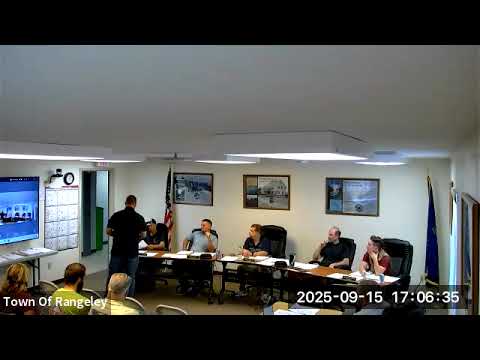
The board invited hauler representatives to explain current practice. Jerry, a representative of Archie's (business), said drivers use a tablet to record routes and start trips with an empty truck, and that “Everything you pick up here, we dump at your transfer station.” He added that the company’s drivers are required to meet Department of Transportation (DOT) requirements and that firms commonly keep records and submit customer lists when towns request them.
Tracy, a town staff member who prepared the packet for the meeting, confirmed the item arose because town officials are planning a “big overhaul” of the transfer station and want to understand existing flow and controls before committing to design changes. Board members asked how the town could verify a truck was empty when it began service in town; hauler representatives suggested licensing and spot checks as common tools used by other municipalities.
Hauler representatives described what a licensing program could require. Examples the haulers cited included a hauler license fee (they gave sample ranges of about $100 to $350), proof of insurance and DOT compliance, driver physicals and drug testing, and a customer list so the town can see which properties a hauler serves. A hauler representative said towns sometimes perform spot checks: “we dump something in your transfer station. We’re about a bunch of bags, put them open, check the mail as addresses. You can try to get a general idea,” to detect repeated loads originating outside the permitted area.
Board members and haulers also discussed resident stickers and pay‑as‑you‑throw options. One town staff member explained the town already issues stickers and that the system varies, with some towns selling a first sticker free and charging for a second sticker (the hauler gave a specific example: “The second one is $5”), and some towns using pre‑paid bags for residents. The hauler representatives said truck tablets can map addresses to help identify town lines, but that those systems do not always automatically flag municipal boundaries.
Board members asked haulers for customer lists to better track where loads originate and whether charges to contract towns are aligned with costs. The haulers said they can report container capacities (for example, 2‑, 6‑ or 10‑yard containers) and cubic yards or tons moved if the town requests that data. Town staff noted the board is considering installation of scales and a redesign of the transfer station as part of the forthcoming capital plan.
The discussion produced no vote or formal action. Board members asked staff to pursue follow‑up options, including gathering customer lists, investigating licensing models used by nearby towns, and considering whether to require proof of residency or a hauler license as part of the transfer‑station redesign. Several board members said they want to review examples from other towns and possible conceptual designs before proposing a licensing ordinance.
The board closed the item after thanking the haulers for coming and said staff would return with options and potential next steps.