Get Full Government Meeting Transcripts, Videos, & Alerts Forever!
Get email alerts on the Family Cameras Long Term Care topic
No spam. Unsubscribe anytime.
Family testimony urges explicit right for families to install cameras in assisted‑living and nursing facilities
Summary
A family member described a delayed hospital transfer after a nighttime fall and urged lawmakers to allow families to install cameras in long‑term care settings, saying cameras can provide evidence and improve care; committee members discussed privacy safeguards and notice provisions in the draft bill.
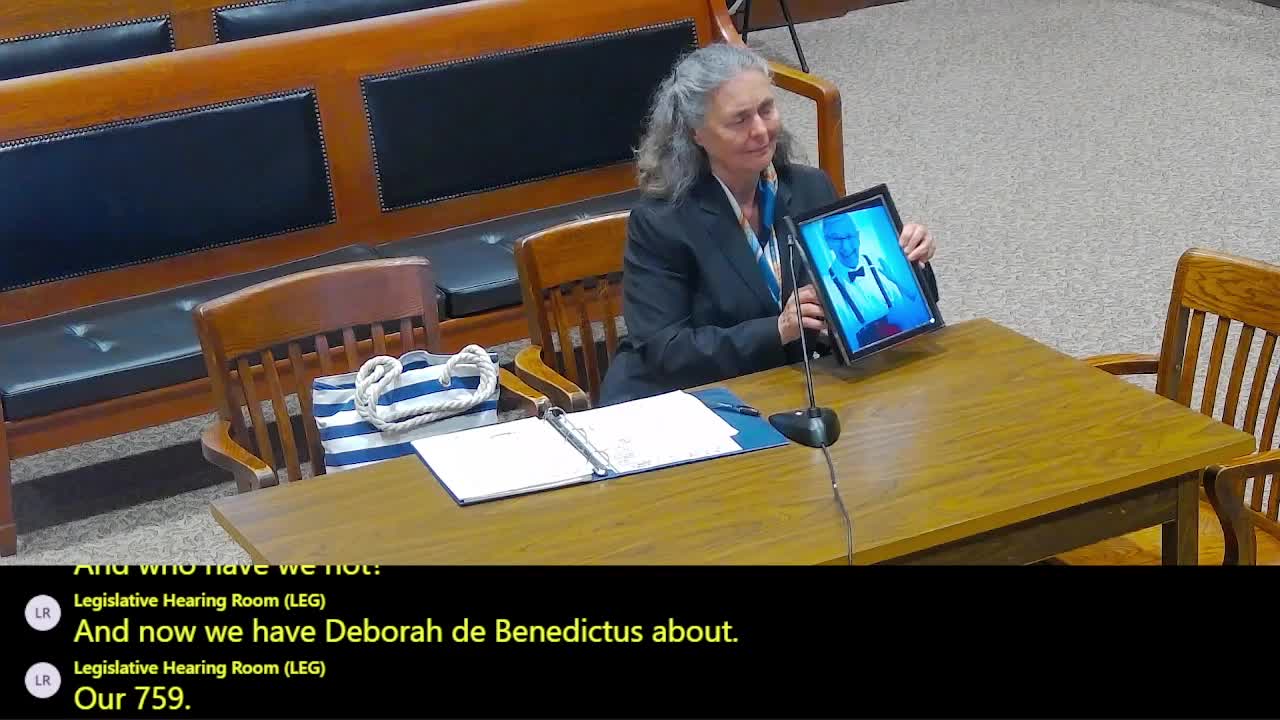
Deborah de Benedictus, speaking about House 759, described using a camera at two facilities where her 97‑year‑old father lived and recounted serious care problems after a fall. “Many residents in nursing homes do not have the capacity to speak out effectively about their care,” de Benedictus said, explaining why she and her family installed cameras. She said one facility where cameras were not permitted failed to produce documentation of the policy; in another facility that allowed cameras, the family used video to document care.
De Benedictus recounted that after a fall around 2 a.m., staff did not call an ambulance immediately; she said her father was not taken to the hospital until roughly 8:30 a.m. and sustained multiple fractures including vertebrae, ribs, a collarbone and a wrist. She said some care staff later described him as “delusional,” which she disputed, and that his care after returning to the facility’s skilled unit required additional paid private assistance for feeding. De Benedictus said these events contributed to her father’s decline and eventual death after more than nine weeks in an ICU.
The witness referenced a news article stating about 20 states have policies allowing cameras in long‑term care settings and told the committee families use cameras most often during late hours when regular nursing staff are limited. Committee members asked whether the draft bill affirmatively permits family cameras and how privacy would be protected; testifiers and legislators said the draft includes notice and guideline provisions and that families should be able to provide written testimony or evidence. De Benedictus agreed to submit written testimony and a copy of the cited article for the committee record.
Committee members acknowledged privacy concerns raised by staff and clinicians but emphasized that witnesses described cameras primarily as tools to monitor aides and overnight care. No committee vote occurred on House 759 at the hearing; the record shows the committee invited written testimony and follow‑up materials to clarify policy language and privacy safeguards.