Get Full Government Meeting Transcripts, Videos, & Alerts Forever!
Get email alerts on the Energy Education Workforce topic
No spam. Unsubscribe anytime.
Office of Energy Development says K–12 energy education reached 20,000 students; advisory group advancing teacher resources
Summary
The Office of Energy Development reported to the committee that the advisory group created by HB157 has met monthly and expanded outreach; OED highlighted curriculum revisions, educator checkout kits and planned field trips for teachers to connect classroom lessons with local energy sites.
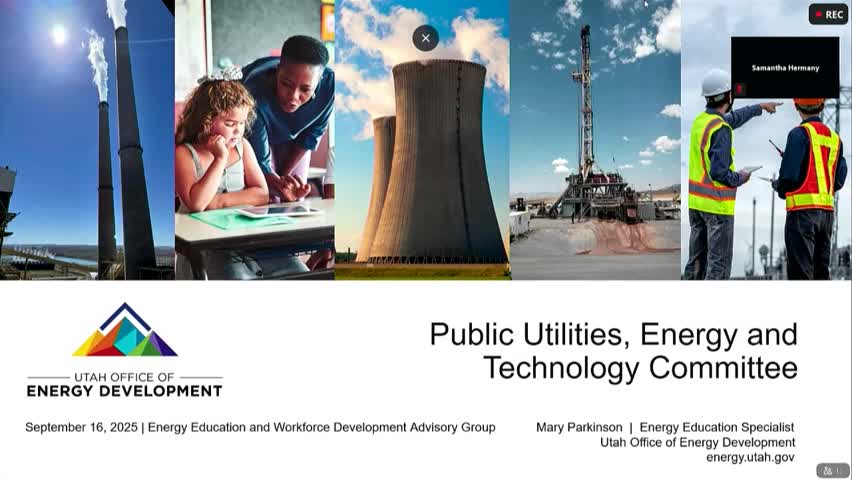
SALT LAKE CITY — The Utah Office of Energy Development told the Public Utilities, Energy and Technology Committee that work to expand K–12 energy education is increasing statewide and that the advisory group created by HB 157 has started turning outreach into classroom resources.
Mary Parkinson, education specialist at the Office of Energy Development, said the advisory group has met monthly since May 2025 and includes members from industry and education, including representatives from the Utah State Board of Education and the Utah Science Teaching Association. Parkinson said ‘‘OED has reached 20,000 students’’ since September 2024, quadruple the prior year’s reach, and that the office expects additional participation at STEM Fest events.
Why it matters: committee members said energy literacy is important for workforce development and longer‑term planning as the state’s energy sector grows. Parkinson said students in grades K–12 often do not understand where electricity comes from and that the advisory group’s work aims to create pathways into energy careers.
Parkinson outlined several near‑term initiatives: revising about 45 lessons for grades 4–12 to better align with state standards and to add educator background and accommodations; piloting educator ‘‘checkout kits’’ that schools or districts could borrow at no cost; organizing educator field visits to energy facilities to earn relicensure credits and connect professional development to on‑site experience; offering virtual field trips and an interactive map showing Utah energy sites; and expanding outreach with STEM support specialists embedded at events and labs such as the Utah San Rafael Energy Lab.
Representative Albrecht asked Parkinson to rank the program’s success on a 1–10 scale; Parkinson replied, ‘‘I think I would give it a 9 in success,’’ and stressed ongoing efforts to expand rural outreach to counties including Emory, Cache, Duchesne and Vernal.
Parkinson told the committee that barriers remain: some hands‑on lessons can be cost‑prohibitive for underfunded schools, professional development does not yet reach as many teachers as desired, and some curricula assume educator familiarity with energy topics. The advisory group plans to pilot resources and move to quarterly meetings in 2026 while reporting progress back to the committee.
No formal committee action was taken on the report; committee members thanked OED for the progress update and urged continued statewide outreach.