Get Full Government Meeting Transcripts, Videos, & Alerts Forever!
Get email alerts on the Pfas Biosolids topic
No spam. Unsubscribe anytime.
Massachusetts committee hears wide support for ban on land application of sludge amid PFAS concerns
Summary
At a joint hearing, farmers, environmental groups and public-health advocates urged the Joint Committee on Agriculture and Fisheries to advance H109/S56 to ban land application of wastewater sludge, create a fund to help affected farms and shield farmers from liability for legacy contamination by PFAS.
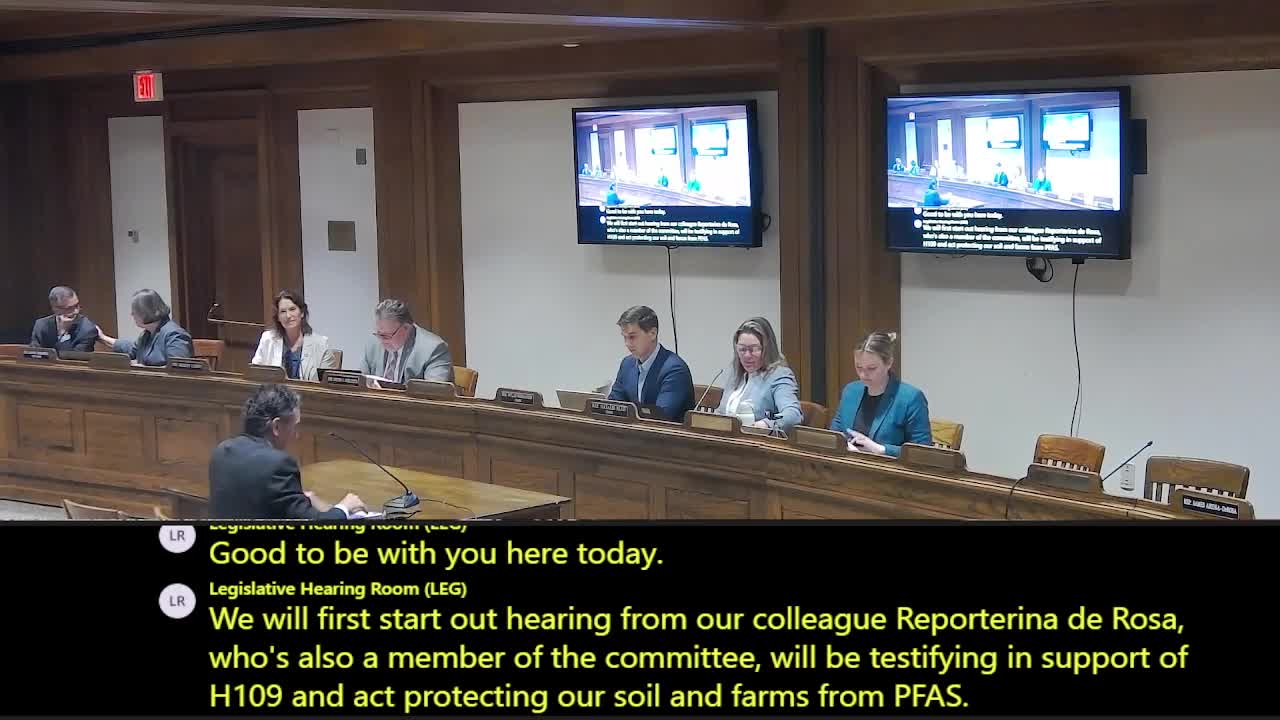
Lawmakers heard extensive testimony Wednesday about proposed legislation (H109/S56) that would ban the land application of wastewater sludge and create an agricultural PFAS relief fund to help farmers facing contamination. Speakers representing environmental nonprofits, farmers and public-health organizations told the Joint Committee on Agriculture and Fisheries that PFAS—so-called “forever chemicals”—are persistent in soils and can move into water, crops and animals.
Advocates described recent findings and practical impacts. “The science is clear that PFAS and sludge poses significant risks to human health and the environment,” said Erica Kaiser McKeown, senior attorney, Conservation Law Foundation. Several witnesses recounted Maine’s experience, where the legislature banned land application and established funding to help impacted farmers; Adam Nordell, who testified about his farm in Maine, said state support had kept many farms operating.
Farm and farm‑support organizations pushed for protections for farmers who followed accepted practices in the past. “Farmers didn’t create these chemicals and shouldn’t have to risk losing their livelihood for following what was considered best practices,” said Susan Murray, executive director of the Southeastern Massachusetts Agricultural Partnership. Witnesses asked the committee to add provisions in the bill that would provide liability protection and direct financial relief and to require testing of fertilizer and soil amendments.
Panelists and public witnesses referenced state and federal studies and testing. Several speakers cited recent Department of Defense notifications to 11 Massachusetts farms near military sites and reported high multiples of the federal drinking‑water standard at some locations. Witnesses also cited state testing showing PFAS in residual products and in some composts and pellets used on agricultural land.
No committee action was taken during the hearing; testimony will be considered as the committee decides next steps. Advocates urged a favorable report so the measures can reach the Legislature’s next stage.
Ending: If the committee advances the bills, advocates said the measures would both stop additional PFAS loading to farm soils and create a pathway to test, remediate and financially assist farms that already show contamination.