Get Full Government Meeting Transcripts, Videos, & Alerts Forever!
Get email alerts on the Gap Grant Round 4 topic
No spam. Unsubscribe anytime.
MassDEP opens $5 million GAP Grant Round 4 for water utilities, food nonprofits and small food businesses
Summary
The Massachusetts Department of Environmental Protection (MassDEP) outlined its fourth GAP grant round at an informational webinar, offering $5,000,000 in competitive awards to support energy-efficiency and clean-energy projects at publicly owned drinking-water and wastewater facilities, eligible nonprofit food and agricultural organizations, and small food-distribution businesses.
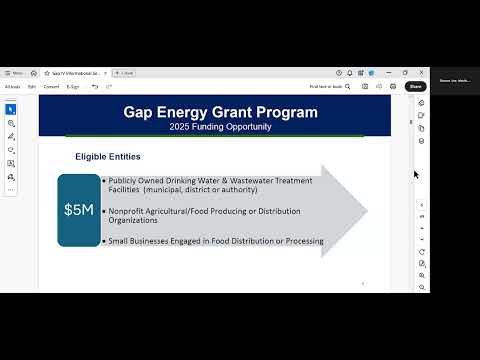
The Massachusetts Department of Environmental Protection (MassDEP) outlined its fourth GAP grant round at an informational webinar, offering $5,000,000 in competitive awards to support energy-efficiency and clean-energy projects at publicly owned drinking-water and wastewater facilities, eligible nonprofit food and agricultural organizations, and small businesses engaged in food distribution and processing. Michael Dabara, project manager for the program, told attendees, “we'll award a total of $5,000,000.”
The grants are intended to lower energy consumption and operating costs at eligible facilities so “those saved dollars [can be] reinvested back into the facilities and communities,” a MassDEP presenter said. The program covers design and construction costs and is reimbursed after projects are built and operating.
Why it matters: DEP said the earlier rounds produced project- and site-level energy savings and leveraged utility incentives and private dollars; the agency said applicants that combine efficiency, renewable generation and demand-response measures can improve competitiveness and long-term operating costs for essential public services such as drinking-water and wastewater treatment.
Key program details - Eligible applicants: publicly owned drinking-water and wastewater treatment plants (including plant buildings and pumping stations), nonprofit food and agricultural entities (for example, community food banks, shared kitchens and distribution organizations) and private small businesses engaged in food distribution or processing. An applicant must show the facility owner’s authorization. - Total budget and award sizing: MassDEP said the GAP 4 budget is $5,000,000. Two funding categories group projects by construction cost: small projects ($75,000 to $200,000 construction costs) and large projects (over $200,000). The maximum award per grantee is $350,000. - Cost share and incentives: A minimum 10% applicant cost share is required; additional cost sharing or third‑party funding (for example utility incentives) can increase evaluation scores. Michael Dabara explained the cost-share calculation: incentives reduce the adjusted project cost and the 10% is applied to that adjusted number. - Reimbursements and timing: DEP said grants are reimbursed after the project is complete and operating; the agency noted partial or progress payments may be considered on a case-by-case basis but should not be assumed. - Application prerequisites and deadlines: Every applicant must have a completed energy assessment, audit or feasibility study before applying. Applicants must preregister in the iMeet online grant system and submit a complete application by 5 p.m. on Sept. 19; MassDEP said written responses to submitted questions will be posted on Sept. 15. Jane Pfister of the Department of Energy Resources is the iMeet contact for application access.
Eligible measures and scoring priorities DEP staff said the list of eligible measures is not exhaustive but must produce energy savings (kilowatt-hours, therms or gallons of fuel) and greenhouse-gas reductions that DEP or a sister agency can evaluate. Typical eligible measures listed include: high-efficiency pumps and variable-frequency drives for pumping systems, high-efficiency heat pumps (noting a specific exclusion for heat pumps that use wastewater as a thermal source in GAP 4), insulation and building envelope upgrades, solar and battery storage, small-scale wind, in-conduit hydropower, geothermal, and microgrid systems. DEP said combining deep-energy retrofits or pairing renewables with storage and participating in demand-response programs will earn additional points in its evaluation.
Demand-response pathways and incentives Two demand-response pathways were presented during the session. William (Bill) O’Connor of Eversource described the Mass Save/Connected Solutions pathways, explaining that targeted dispatch typically calls three to eight three‑hour events in summer peak months while a daily-dispatch track can call dozens of events to capture more peak hours. O’Connor said the programs use interval data and weather adjustments to calculate curtailment and that batteries are particularly well suited to repeated daily dispatch. He described the typical payment structure to participants and said the program has removed hundreds of megawatts from summer peaks across the region.
Phil, a CPower representative, described CPower’s role aggregating customer flexibility and monetizing curtailment across multiple markets, saying, “You perform, you get paid. If you don't perform, you don't get paid.” He added that program participation is pay-for-performance and that there are generally no penalties or upfront costs for participants. Both presenters noted an additional evaluator scoring bonus (a 5‑point adder) for applicants who commit to participating in demand-response programs.
Metering and enrollment Presenters and DEP staff explained that enrollment typically requires interval metering or a meter pulse/gateway that provides five- or fifteen-minute usage data; Eversource can often provide historic interval data for initial screening, and real-time or near-real-time telemetry is added once a site enrolls in an active program. DEP staff and the vendors emphasized there is technical assistance available for data access and site qualification; they said customers must usually authorize utilities to share meter data with third-party program managers.
Questions and agency clarifications During the Q&A, DEP clarified several procedural points: the 10% cost share is calculated on the adjusted project cost after utility incentives; the $350,000 maximum applies per grantee entity (for example, a municipality) and does not permit separate, duplicative $350,000 awards to distinct municipal departments; the energy assessment is a prerequisite to apply and may be provided by Mass Save program vendors, municipal lighting plants or qualified consultants; applicants should not assume reimbursement for pre‑contract expenditures — DEP called that an at‑risk spend. DEP said it will respond in writing to questions it could not answer on the call and will post those responses by Sept. 15.
What applicants should do next MassDEP urged interested applicants to preregister in the iMeet portal immediately, complete the energy assessment prerequisite, assemble documentation (applicant information, funding overview, certification forms, technical energy worksheets) and upload supporting letters (for example, utility incentive commitment letters) before the Sept. 19, 5 p.m. deadline. Jane Pfister (Department of Energy Resources) is the contact for iMeet access and application workspace setup.
Ending DEP staff closed by reminding applicants that earlier GAP rounds funded dozens of municipal plants and that pairing efficiency, renewables, storage and demand-response participation can improve competitiveness; they asked applicants to monitor the agency’s website for the webinar recording, slides and the written Q&A posted Sept. 15.