
District rolls out ParentSquare and outlines multi‑year communications plan after survey
Get AI-powered insights, summaries, and transcripts
Subscribe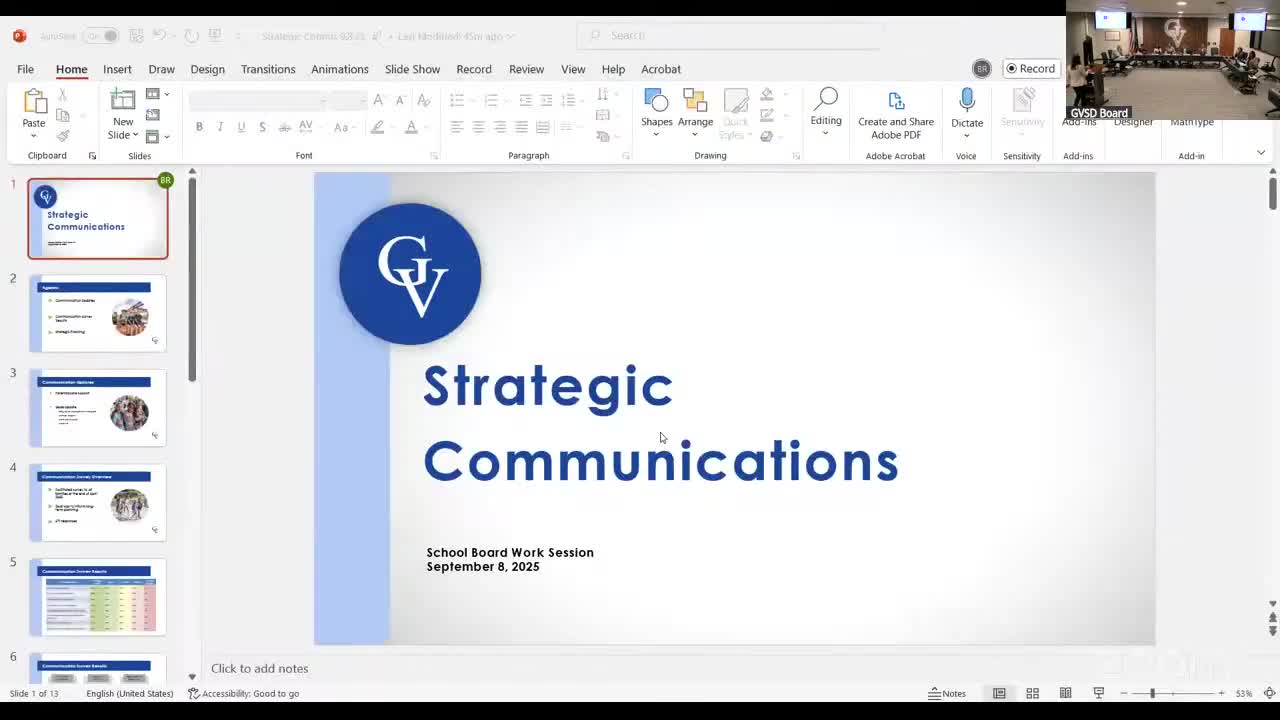
Summary
Great Valley School District rolled out ParentSquare this summer, reported early adoption numbers and survey results, and said it will deliver a full three‑year communications plan to the board in February.
The Great Valley School District on Wednesday told its board that a districtwide communications overhaul is underway after early ParentSquare adoption and a 12‑question family survey produced areas for improvement. Teresa Marsden, a communications staff member who led the presentation, said the district launched ParentSquare in August and as of the board meeting had “over 3,700 parents who have registered their accounts and over 1,600 who have downloaded the mobile app.” She said the district has scheduled two information sessions for families — Sept. 25 and Oct. 7 — and has received positive feedback from parents and staff about the tool’s usability. Marsden framed the work around three pillars: community engagement and partnerships, building the district brand, and digital connection and accessibility. She said the district’s spring communications survey drew 671 responses and that most respondents “fell within the category of agree” on satisfaction items, with combined agree/strongly agree roughly in the mid‑50s to 60 percent range for many questions. Why it matters: Marsden told the board the survey identified consistent gaps the communications plan will target — transparency, two‑way communications and responsiveness — and that the district intends to standardize how it notifies families about major initiatives, safety and curriculum changes. She said the communications plan will include multi‑year action steps and that she will present the full plan to the board for feedback in February. Board members praised the early work and asked about specific elements. One board member, Neha (last name not specified), asked whether the mid‑50s to 60 percent satisfaction level is typical; Marsden replied that in her experience that combined agree/strongly agree range “is pretty on par with satisfaction levels,” and cautioned that the neutral response option may have muted stronger signals. Another board member asked whether crisis communications were included; Marsden said crisis communication and safety and security are intended parts of the initiative framework and that she has already begun coordinating with Andrew Thurston on the safety piece. Marsden described several concrete short‑term changes already made to improve user experience: she said the district relocated the district calendar to a more prominent place on the home page, added clear instructions on how to filter the calendar by school, and added an “absence reporting” button on the home page so parents no longer need to navigate to individual school pages to report a student absence. She also noted early program metrics and engagement: the Hart Award nomination application had “over 50 nominations” across staff and community nominators, and the district plans a digital annual report with a postcard and QR code to the full report later this month. On digital accessibility, Marsden reminded the board that “all public websites have to be fully ADA compliant by April 2027,” and said the district’s vendor, FinalSight, provides accessibility checkers. Marsden proposed an accessibility guide for staff and training on accessible fonts and digital content. Discussion versus decision: the presentation was informational; the board did not adopt a communications policy at the meeting. Marsden will return with a full strategic communications plan in February for board feedback. Ending: Marsden said some action steps remain intentionally broad to allow for follow‑up and staff input; she described this fall as a period of planning and stakeholder engagement before presenting a full plan in February.