
Health board grants variances for after-the-fact tight tank at 606 Canal Street
Get AI-powered insights, summaries, and transcripts
Subscribe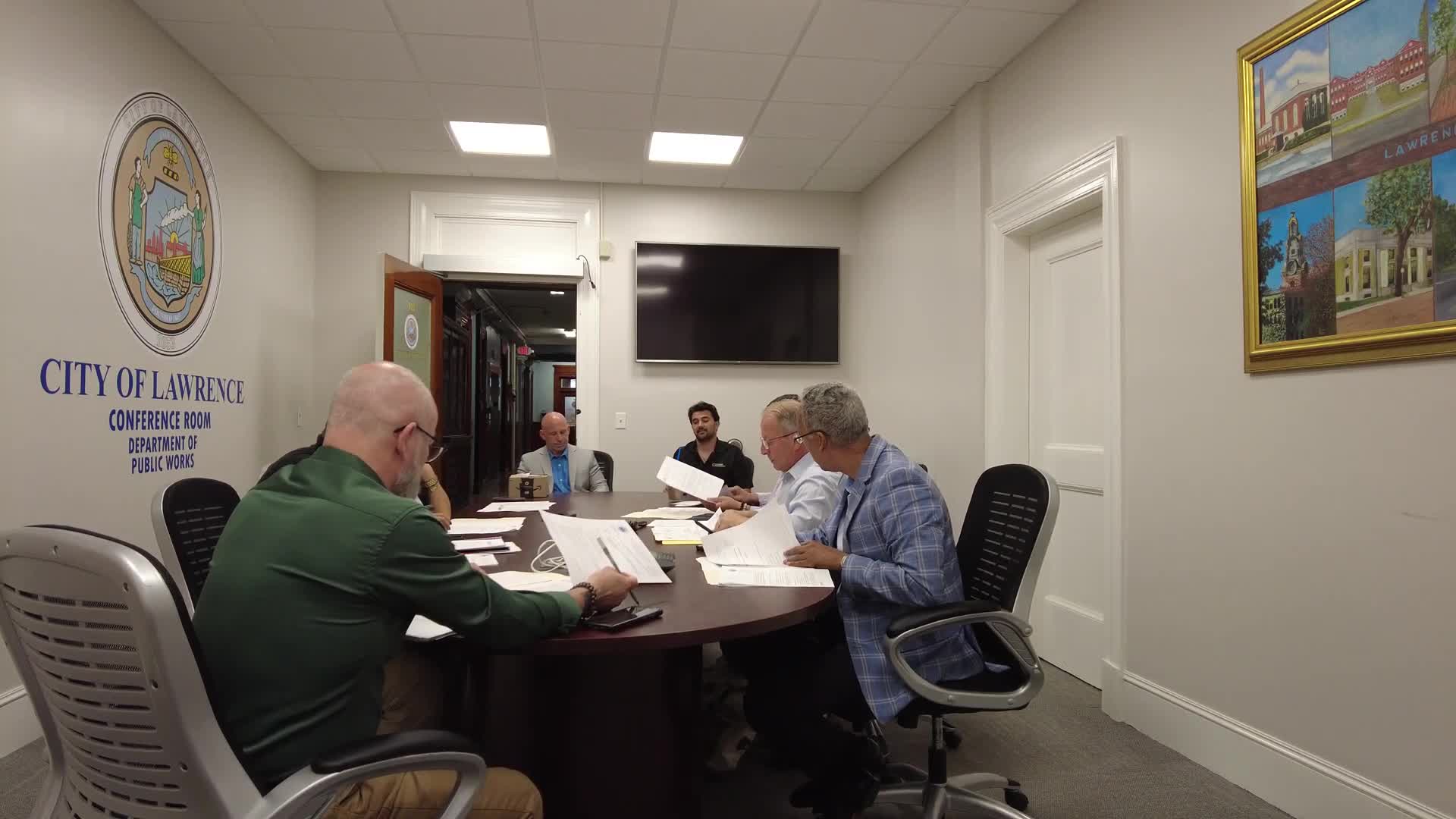
Summary
The Lawrence health board granted multiple local upgrade approvals and variances Sept. 9 to allow an existing, after-the-fact tight tank at 606 Canal Street to remain and operate, while imposing conditions including a cast-iron access frame and an operations plan.
The Lawrence Health Department granted multiple variances Sept. 9 to allow an existing tight tank serving 606 Canal Street to remain in place and operate, after an engineer told the department the tank had been installed without required permits. The board approved a reduced tank-size allowance, an after-the-fact installation variance and a requirement to replace the tank’s plastic cover with a cast-iron frame.
The action followed a presentation by Alec Changers of Changers Engineering, who summarized the Title 5 (310 CMR) requirements that ordinarily apply to sewage-tight tanks. Changers said the code requires a tight tank "to be sized at a minimum of 500% of the system's sewage design flow and...in no case be less than 2,000 gallons," but that the existing installation at 606 Canal Street is a 1,000-gallon tank and the parcel is too small to accommodate a larger unit. "We need to request a variance to allow it to only have a 1,000 gallon tank," he said.
Changers told the board he estimated the property’s sewage design flow at about 200 gallons per day, which technically meets the 500% sizing ratio but not the 2,000-gallon absolute minimum. He also described other Title 5 items: alarms and pumping frequency, a required operations and maintenance plan, the need for a watertight tank and a requirement that the tank have year-round pumping access. Changers said the installed concrete tank appears watertight and that pumping would likely be needed every one to two weeks depending on use.
Board members moved through individual votes on the requested approvals. The board approved a variance to the sizing requirement to allow the existing 1,000-gallon tank, approved an after-the-fact variance for installation without prior stamped plans, and approved the replacement of the existing plastic cover with a 24-inch cast-iron frame and cover. The board also discussed, and a speaker representing the owner requested, turning on municipal water service contingent on these approvals.
The board conditioned continued use on compliance items described by Changers: confirmation or adjustment of alarm set points, submission of an operations and maintenance plan, pumping by a licensed septage hauler, and replacing the plastic lid with a cast-iron frame at finished grade. Changers recommended the cast-iron frame for safety and to prevent surface-water entry; he estimated the cover replacement cost "probably between...not more than a thousand dollars."
The board noted the site’s constraints: the parcel is narrow, much of it lies within the Merrimack Valley Canal resource area, and the installed tank is substantially exposed. The record shows the board’s approvals were granted at the meeting and that staff will follow up to ensure the required documentation and corrective work are filed and completed before full, continued operation.
Clarifying details discussed during the presentation included an engineer’s design-flow estimate of about 200 gallons per day, the existing tank capacity at 1,000 gallons, and the Title 5 absolute minimum size of 2,000 gallons for tight tanks absent a variance. The board also required visual/audible alarms and an operations schedule for pumping and disposal by a licensed septic hauler.
The board’s approvals allow the property owner to proceed under the specified conditions; staff will verify compliance and the required documentation before the department considers any additional permissions such as utility activation.