
Program reports federal grants executed; updated cost estimate and finance plan to be completed before year‑end
Get AI-powered insights, summaries, and transcripts
Subscribe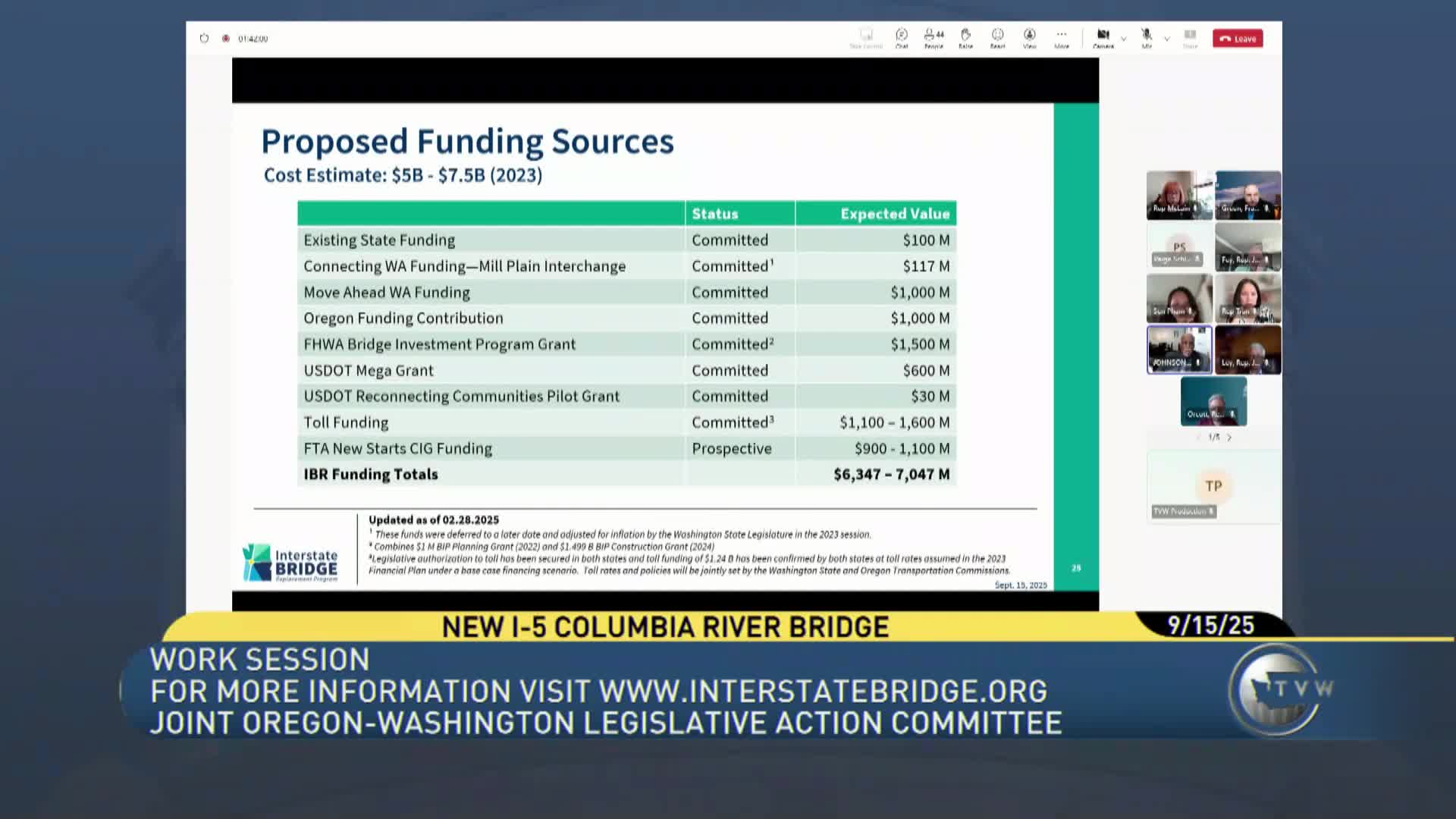
Summary
Staff told legislators the program has executed federal grant agreements (including a $600 million MEGA and $1.5 billion Bridge Investment grant) and that an updated, risk‑based cost estimate and finance plan will be completed for committee review by December 2025.
Program staff updated the committee that the Interstate 5 Bridge program has executed major federal grant agreements and is preparing an updated cost estimate and finance plan to reflect advances in design and market conditions. Frank Green, assistant program administrator, told the committee the program has executed agreements tied to a $600 million MEGA grant and a $1.5 billion Bridge Investment Program grant and said both agreements were executed in early 2025 to enable use of funds for preliminary engineering. He added the program also received a $30 million reconnecting communities grant to support a downtown‑to‑Fort Vancouver connection.
Why it matters: Staff said the grants were a prerequisite to using federal funds for preconstruction work but that the bulk of right‑of‑way and construction obligations cannot be executed until the program receives a ROD. Frank Green said the program will run a risk‑based cost estimate validation process using the current 30% design level to produce updated base costs, schedule, inflation and risk contingencies. He told the committee the updated estimate will model both a fixed‑span and movable‑span outcome and incorporate more than 100 project‑specific risk factors.
Schedule and STIP amendments: Greg Johnson and Frank Green told the committee the Washington State Transportation Improvement Program (STIP) amendment has been approved. On the Oregon side, the program has Metro and JPAC approval for an STIP amendment and must still get approvals from the Oregon Transportation Commission and the Federal Highway Administration in Oregon.
Revenue assumptions: Staff reiterated current finance planning targets that put the toll funding contribution in a range of $1.1 billion to $1.6 billion with a working expectation nearer $1.2 billion, subject to the updated cost estimate, the level‑3 traffic and revenue work, and commission rate decisions. The committee was told an updated cost and finance package would be presented to the joint committee at a December meeting.
Ending: Staff asked legislators to submit follow‑up questions in writing and noted that updated cost, schedule and procurement details will inform upcoming procurements and the program’s progressive design‑build strategy for the largest packages.