
Coast Guard navigation finding will determine fixed or movable span; movable option could add roughly $400 million, officials say
Get AI-powered insights, summaries, and transcripts
Subscribe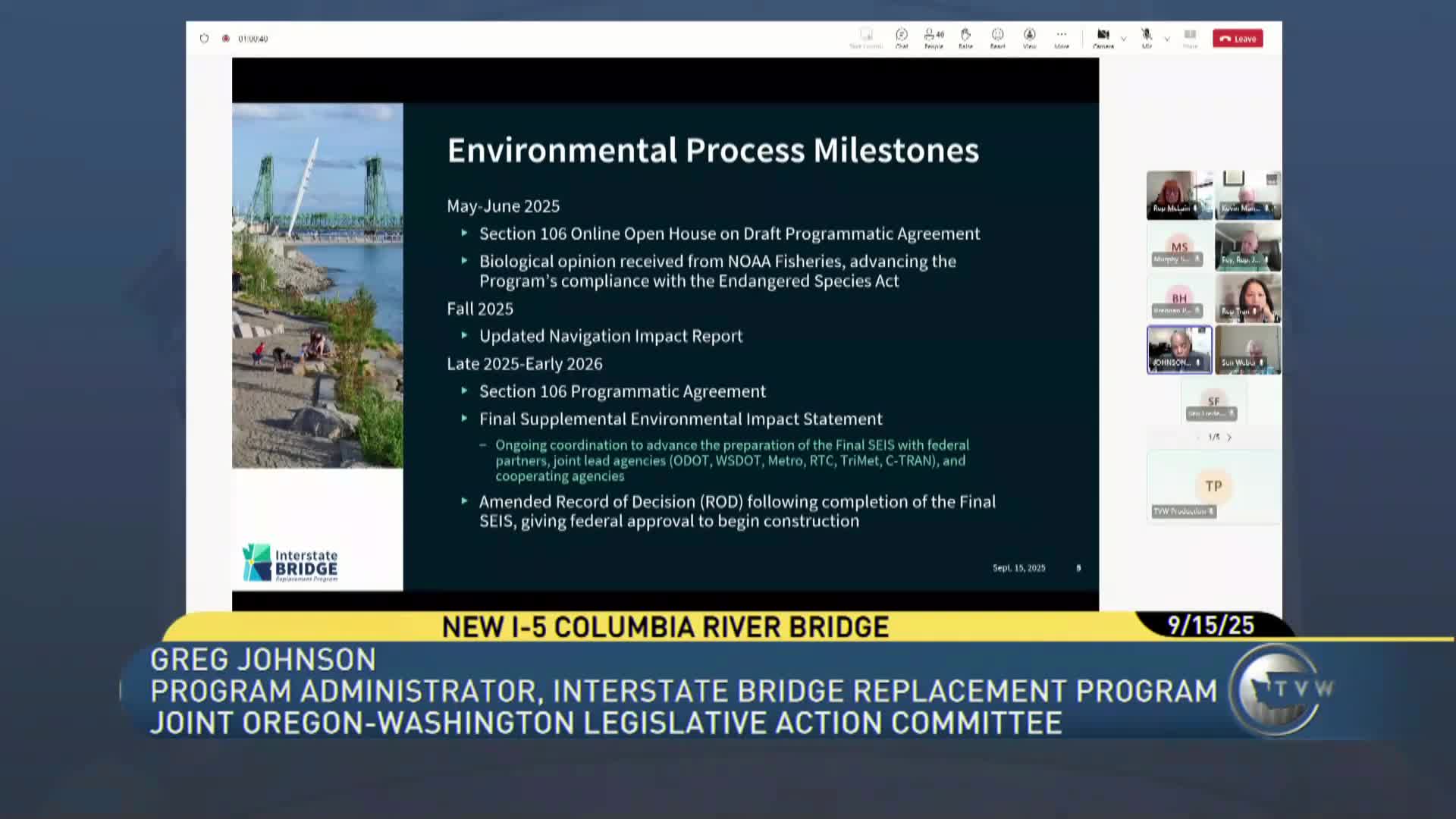
Summary
Program staff told legislators that the Coast Guard’s preliminary navigational clearance will determine whether a fixed 116‑foot clearance or a movable span is required, and said their last estimate put a movable span at about $400 million more than a fixed span.
The committee was told Sept. 15 that the U.S. Coast Guard’s navigational decision will be decisive in whether the Columbia River crossing is built as a fixed span or as another movable span. Greg Johnson, program administrator, said the program will submit an updated navigational impact report and that "the determination that the Coast Guard gives us will be that preliminary navigational clearance determination," which will inform the federal record of decision.
Why it matters: A movable span changes design, procurement and construction approaches, and staff warned it would substantially increase cost. When Representative Lee asked whether construction could still begin in 2026 if the Coast Guard requires 178 feet of clearance, Johnson replied that the movable span would be more costly and that the program had "pegged that cost at over $400,000,000 additional to build a movable span."
Discussion: Staff said they are preparing both fixed‑span and movable‑span designs through the NEPA process so the environmental review evaluates both possibilities. If a movable span is required, Johnson said the program is meeting with designers and contractors experienced in movable spans to integrate that option into the cost, schedule and procurement plans. He added that some fixed‑span elements could begin construction on the original schedule even if a movable span portion remains to be procured.
Other factors: Johnson also told the committee that the program has engaged governor’s offices on maritime‑use executive orders (described in testimony as "maritime supremacy executive orders") and that the Coast Guard submittal awaits final sign‑off from those offices.
Ending: Staff emphasized the Coast Guard finding will be a major determinant of configuration, cost and schedule and said they will incorporate either outcome into an updated cost estimate and finance plan to present to the committee later this year.