
I‑5 bridge program stays in supplemental EIS, teams target record of decision in early 2026
Get AI-powered insights, summaries, and transcripts
Subscribe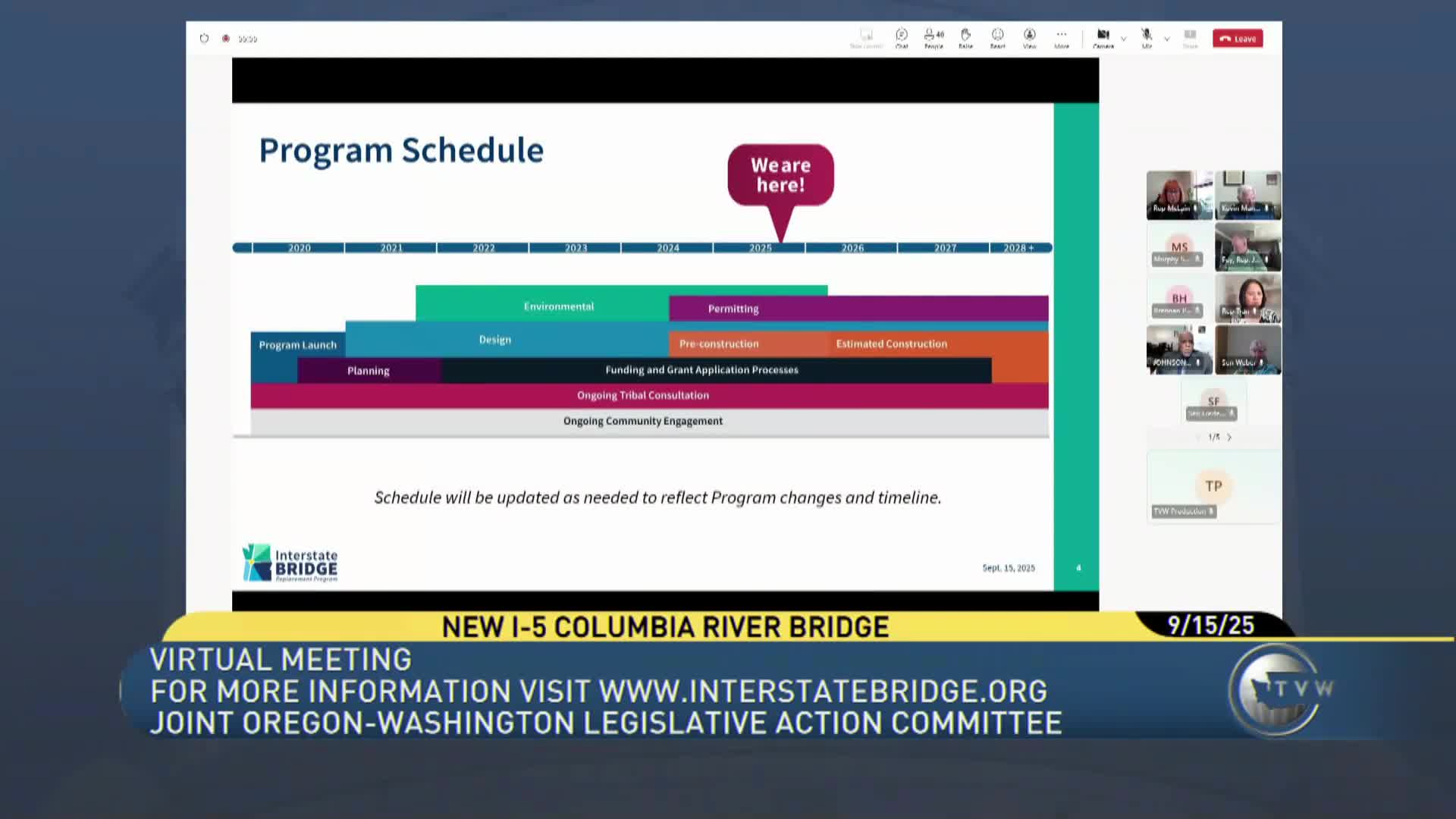
Summary
Program staff told the Oregon–Washington joint committee that the Interstate 5 bridge replacement remains inside the supplemental environmental impact statement (SEIS) process and that federal approvals needed to move to construction are targeted for early 2026.
The Oregon–Washington joint legislative committee on the Interstate 5 Bridge heard on Sept. 15 that the replacement program remains in the supplemental environmental impact statement process and staff are aiming for a federal record of decision in early 2026. Greg Johnson, program administrator, told the committee the project is still in "the green environmental box," adding, "we are hoping to move out of that process in early 2026."
Why it matters: A record of decision (ROD) from federal regulators is required before most of the program’s federal grant obligations can be finalized and major construction contracts advertised. Without the ROD, staff said, some federal grant funds cannot be used for construction and the program cannot obligate key federal dollars.
Program staff summarized milestones completed and remaining. They said the program has obtained a NOAA Fisheries biological opinion concluding the project can comply with the Endangered Species Act and that staff are finishing a programmatic Section 106 agreement to address historic properties and inadvertent archaeological finds. Johnson said a navigational impact report will be submitted to the U.S. Coast Guard soon; that report and the Coast Guard’s preliminary navigational clearance will influence whether a fixed span or movable span is selected for the main river crossing.
The committee heard that tribal consultation has been active: Johnson said the program is consulting 10 federally recognized tribes and said, "their input is absolutely vital to how we move forward with this program." Staff also described continuing local engagement — more than 100 outreach activities this year and roughly 18,000 website visitors — and said recorded design and architecture workshops are on the program website.
What remains unresolved: The Coast Guard’s navigation determination and a finalized programmatic agreement under Section 106 are among the outstanding items Johnson and other staff identified as prerequisites to the SEIS record of decision. The program repeated that the SEIS and then an amended ROD are the next major federal steps before moving into construction.
Discussion vs. decision: Committee members pressed staff on schedule slippage and costs; staff acknowledged prior expectations that a ROD might arrive sooner and said federal partners required additional review that extended the timeline. No new policy commitments were made at the Sept. 15 meeting; staff presented status and requested questions to be submitted in writing for follow-up.
Ending: Staff told the committee they expect the final SEIS and an amended ROD in early 2026 and that, after the ROD, the program will begin obligating grants and advertising major construction procurements.