
Fargo commission considers state law changes to public‑comment rules; vote leaves current practice unchanged
Get AI-powered insights, summaries, and transcripts
Subscribe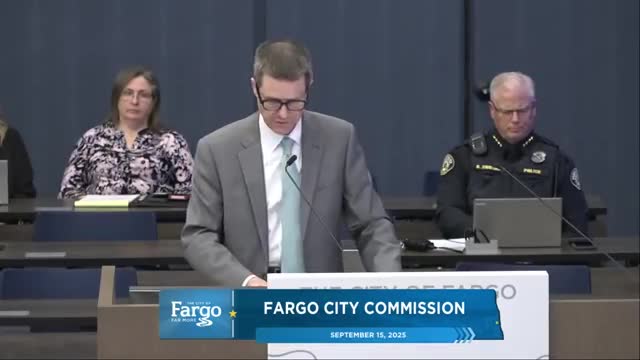
Summary
Staff presented options to align the City of Fargo's public‑comment policy with North Dakota Senate Bill 2180. After debate, a motion to limit speaker remarks to items on the current agenda (and the preceding agenda) failed; no changes were adopted and virtual comment remained available under the city’s current practice.
The Fargo City Commission reviewed proposed revisions to the city's public‑comment policy meant to align procedures with changes in North Dakota law (Senate Bill 2180). Staff presented three options: limit public comment to items on the current and immediately preceding agendas; remove virtual testimony altogether; or keep the current practice that permits both in‑person and virtual commenters regardless of residency.
Staff attorney Michael Redlinger and city staff explained that the state law change removed the residency or business‑ownership requirement for public commenters and that the city can choose whether to provide virtual options beyond the statutory minimum. Commissioners debated the tradeoffs between limiting comments to agenda items to keep meetings focused and preserving open access and transparency for residents and border‑area stakeholders.
Several residents who regularly attend meetings urged the commission not to adopt stricter limits. Virtual speaker Olivia Fisher said limiting non‑agenda comments and virtual testimony would “silence” border‑area residents and reduce transparency. Christopher Cohen and other commenters urged the commission to exceed the state minimum and retain broad public comment opportunities so citizens can raise issues that may not otherwise appear on an agenda.
When the commission voted on motion number 1 — to restrict resident comment to agenda items and the immediately preceding agenda item — the roll call recorded two ayes and three nays, so the motion failed and the status quo remained. The commission did not adopt motion 2 options to restrict virtual comment; staff recorded that without a motion the current virtual procedures remain in place. Several commissioners said they would revisit the question if out‑of‑state or nonresident commenters created problems in future meetings.
The discussion clarified that under the state change the city need not provide virtual testimony, but Fargo staff recommended retaining virtual comment to preserve access for people who cannot attend in person. The commission asked staff and legal counsel to help draft any future policy changes if members later decide to narrow the public‑comment window.