
Knox County Planning Commission approves large Messana subdivision after contentious debate over hillside protection
Get AI-powered insights, summaries, and transcripts
Subscribe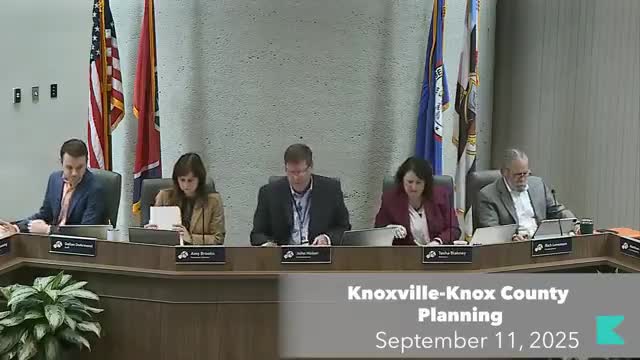
Summary
After hours of debate over hillside disturbance, density and multiple variances, the Knoxville−Knox County Planning Commission approved Messana Investments’ concept and development plans — including variances and alternative design standards — by 9–4 votes with conditions.
The Knoxville−Knox County Planning Commission on Sept. 11 approved a concept plan and subsequent development plan from Messana Investments that would allow a large residential subdivision with up to 127 single-family homes and 132 attached homes after commissioners accepted a series of variances and alternative design standards.
The commission approved the concept plan subject to 14 staff conditions and later approved the development plan with four conditions; both votes were 9 in favor and 4 opposed. Commissioners spent more than two hours debating potential environmental impacts and whether the plans complied with prior zoning conditions and the county’s hillside and ridgetop guidance.
Why it matters: The proposal covers a large tract of land and drew sustained public comment from nearby residents worried about hillside disturbance, traffic and loss of rural character. Planning staff and engineering supported many of the applicant’s requested variances and alternative design standards, but several commissioners said they remained concerned about overall disturbance to hillside and ridgetop areas.
The developer, Scott Davis, told commissioners the project team has agreed to withdraw three units that exceeded density limits in a portion of the site and to move an amenity center and add sidewalks and a boulevard. “We are agreeable to withdraw those 3 units,” Davis said, adding the developer would revise the boulevard length and look at narrower cross-sections to reduce grading. Engineering staff told the commission they were “comfortable” recommending approval of the variances based on the applicant’s justifications.
A major point of contention was the planning staff’s analysis showing the site’s proposed disturbance exceeded the recommended hillside protection budget across the entire property. Staff said the recommended disturbance for the hillside protection area was roughly 2.3 acres and that the proposal exceeded the recommendation by about 76 percent. Commissioners noted the rezoning on a six-acre front parcel included a condition tied to the county’s hillside guidance; staff said the commission retained discretion to modify that condition.
Commissioners also approved nine individual variances and 11 alternative design standards during the meeting after engineering indicated support. The engineering representative said the boulevard alignment was requested in part to provide two means of access and to meet life-safety access requirements where longer developments require additional access points.
Several neighbors spoke during public comment, describing concerns about steep slopes, stream crossings and existing site disturbance associated with earlier phases of nearby developments. William Sofield, who said his property borders the site, told the commission he was “opposed to the rezoning of this based on the density of the housing” and raised concerns about traffic and erosion. The applicant and staff repeatedly pointed out that many required environmental and permitting reviews will occur at the design/permit stage and that approvals granted by the commission address the concept/development plan and certain conditions, not final construction details.
Outcome and next steps: The commission recorded the concept plan approval 9–4 and then approved the development plan 9–4. The approvals were conditioned on the list of items distributed at the meeting — including the developer’s written commitment to not exceed the allowed density on the PR‑2 zoned portion and development‑stage measures to reduce grading and implement reforestation or grading reductions where required. Staff and engineering will verify compliance with the conditions during subsequent permitting and design reviews.
Quotes “Everything we do here, we approve conditional upon x y z,” Amy Brooks, executive director of Knoxville Knox County Planning, told commissioners while explaining staff’s role. “Planning staff cannot recommend approval of any plat remaining incomplete after this deadline.”
“From a life safety perspective, we think that boulevard is warranted here,” the engineering representative said when explaining the two‑access rationale.
The ending: Commissioners who opposed the approvals said they were not satisfied that the disturbance budget and hillside guidance had been sufficiently addressed; those who supported the approvals pointed to the negotiated reductions in density on the most sensitive front parcel, engineering support for variances, and the list of conditions that will be enforced during permitting.