Get Full Government Meeting Transcripts, Videos, & Alerts Forever!
Get email alerts on the Public Safety Dispatch topic
No spam. Unsubscribe anytime.
Strongsville council votes 4-3 to join Chagrin Valley regional dispatch after heated debate
Summary
After extended debate about cost, staffing and local control, Strongsville City Council adopted an ordinance to join the Chagrin Valley Regional Communication Center in a 4-3 vote. Supporters cited economies of scale and career opportunities; opponents stressed local knowledge, staffing impacts and long-term costs.
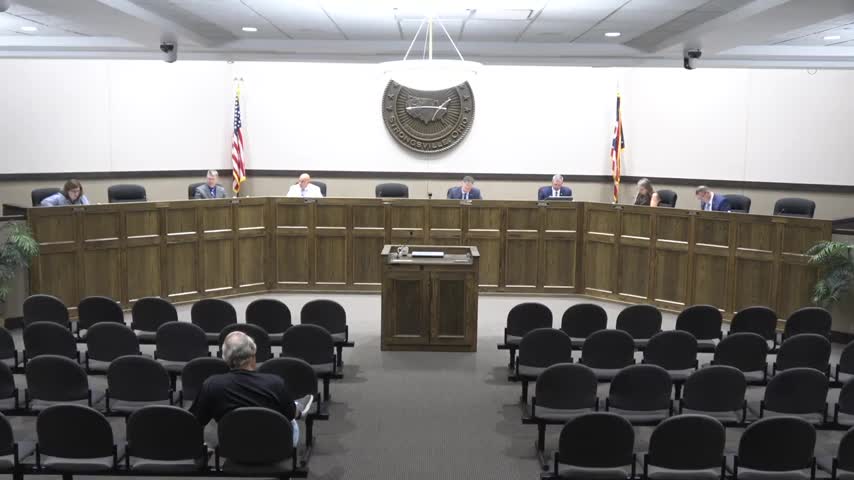
Strongsville City Council voted 4-3 on Sept. 15 to authorize the city to join the Chagrin Valley Regional Communication Center for public-safety dispatching, approving Ordinance 2020586 after hours of discussion and public comment.
The measure’s passage means the city will enter a member-participation agreement with Chagrin Valley Dispatch (CVD) rather than continue operating its own standalone dispatch center. Council moved to adopt the ordinance following a roll call recorded as: Short — yes; Carbone — no; Kaminski — yes; Kosick — no; Clark — yes; Roth — no; Spring — yes. The motion to adopt was made by Councilman Carbone and seconded by Councilman Kaminski.
Councilwoman Kelly Kosick, who led the floor discussion opposing the ordinance during the reports of council committees segment, said Strongsville is “unique” and argued the city would lose control over costs and local relationships if it joined the larger regional center. “If we join CVD, we will lose the connection that our first responders have to our fire medics and our police officers,” Kosick said, adding that Strongsville’s industrial and retail composition made it distinct from many CVD member communities.
Administration staff presented a cost comparison during committee discussion. A staff member identified as Eric said the Chagrin Valley contract “is going to cost the city probably around $1,240,000,” based on the ordinance before council. He told council that, by contrast, keeping a dispatch center in Strongsville at the staffing levels modeled for the city would raise costs by about $522,000 on top of current operations, producing a projected total near $1,760,000.
Opponents of the move emphasized nonfinancial factors. John Douglas, president of the Strongsville Firefighters Association Local 2882, told council the city had the fiscal capacity to keep local dispatching and urged the council to preserve jobs and local expertise: “The city has over $25,000,000 in their general fund… If the $500,000 a year is that much of a concern for this city, we could literally pay that out of the general fund for the next half century and never run out of money,” he said.
Bob Sirmak, a resident who spoke during audience participation, said regionalizing would dilute dispatchers’ local knowledge and relationships with police and fire personnel. “Our dispatchers know the city… That’s something you can’t put a price tag on,” Sirmak said.
Supporters of joining CVD argued the regional model offers staffing depth during large-scale emergencies and improved career paths for dispatchers. Councilman Kaminski said Chagrin Valley provided “better career opportunities, better salary, better chances for advancement” that workers he spoke with preferred. He also argued that in a major crisis a regional center could better handle spikes in call volume.
Council members debated several alternatives during the discussion, including forming a smaller council of governments (COG), partnering with neighboring cities on a local regional center, or maintaining a city-run center while marketing services to other communities. Police-staffing and supervision arrangements, record-management software compatibility and state requirements for LEADS access were also raised by council and staff.
The ordinance passed on final reading and was declared an emergency. The council did not vote on a follow-up motion to assign staff to solicit other municipalities to join a Strongsville-based center. Council members and administration officials said future operational details — including exact staffing, supervisory assignments and where payroll costs would be recorded — would be resolved in implementation planning.
Because council debate and public comment raised open operational questions (job transfers, who supervises dispatch, and long-term capital and software costs), council’s decision directs the mayor to execute the participation agreement; it does not by itself set final staffing rosters or detailed budgets for the new regional relationship.