Get Full Government Meeting Transcripts, Videos, & Alerts Forever!
Get email alerts on the Police Surveillance Policy topic
No spam. Unsubscribe anytime.
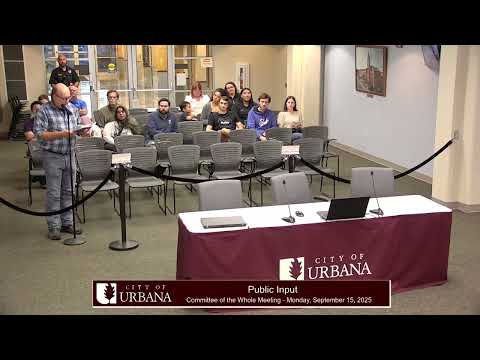
Urbana committee continues lengthy discussion of police surveillance ordinance; no final vote
Summary
The Committee of the Whole continued discussion of a proposed ordinance that would require City Council approval and public reporting before the city may use certain surveillance technologies or surveillance-derived databases.
The Committee of the Whole held extended discussion but took no final action on a proposed ordinance that would require City Council approval before the city or its departments acquire or use specified surveillance technologies or surveillance-derived databases.
Council Member Grace introduced a staff-produced comparison between Urbana’s draft ordinance and Oak Park’s ordinance and walked the group through procedural differences: proposed public-notice and comment periods for new technology (60 days notice, 45 days open comment in Urbana’s draft versus 30 days in Oak Park), a 120-day window for departments to submit use policies for technologies already in use after passage, and differing approaches to contract approval and nondisclosure agreements. Council and staff debated shortening or keeping the longer notice periods.
Members questioned how the draft treats data that was collected without authorization and whether the city can lawfully destroy or refuse to use such data. The city attorney said deletion before state records review may be legally risky; the city would need to follow the Illinois Local Records Act and likely proceed conservatively on destruction absent clear legal authority. Staff said draft language intends to require deletion of data from unapproved surveillance systems “as soon as possible in accordance with state and federal law” and to permit limited exceptions such as court orders or active criminal-defense uses.
Council discussed the scope of the ordinance—whether it should cover only technology that performs surveillance (for example, biometric analysis or license-plate readers) or any database that later is linked with surveillance tools. Several council members and staff agreed to tighten definitions so that database provisions apply only when data is used in conjunction with a surveillance tool, rather than sweeping in unrelated city databases.
Other topics included: whether civilian oversight bodies (the Civilian Police Review Board and the Human Rights Commission) should review and receive complaints relating to surveillance use; whether contracts submitted to council should be unredacted and whether NDAs should be permitted; requirements that the city not sell surveillance-derived data; and an emergency (exigent) use provision that would allow short-term use of unapproved technology for specified emergencies with reporting back to council. Staff said the ordinance would permit technical security patches but would require that any upgrade that adds new surveillance capability go through the approval process.
Grace said the next steps are to refine definitions, tighten language around when an ordinary database becomes a “surveillance database,” clarify oversight and complaint procedures, and return with a redlined ordinance. No final vote was taken; the item remains under discussion.