
Kane County environmental office proposes fee increases, shifts $70,000 in salaries to riverboat fund; sets two-year electric aggregation term
Get AI-powered insights, summaries, and transcripts
Subscribe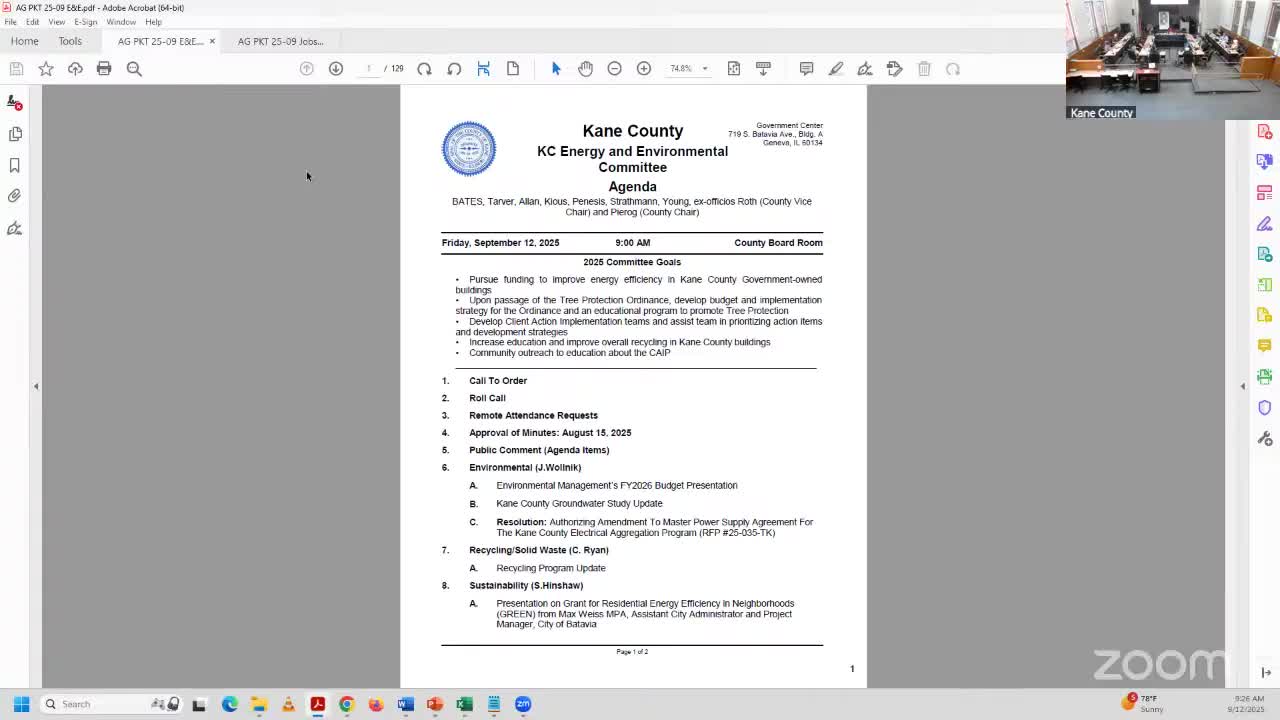
Summary
County environmental staff reviewed the 2026 budget proposals including modest fee increases and a proposal to shift $70,000 in salary costs to the riverboat fund; the committee also set a 24-month term for the county's electric aggregation agreement.
KANE COUNTY, Ill. ' Kane County's environmental department presented a review of its 2026 budget to the Energy and Environmental Committee on Sept. 12, proposing modest fee increases, a reallocation of salary costs to a riverboat special-revenue fund and a 24-month term for the county's electric aggregation agreement.
Presenter Jody Wolnick said the department compared 2024 actuals with the proposed 2026 budget and expects a small overall decrease from 2024 after proposed revenue adjustments. To close a roughly $11,235 increase in salary and commodity costs compared with 2024, staff proposed three revenue changes: a conservative stormwater fee increase expected to raise stormwater revenue from a typical $20,000 budget to $25,000 (a roughly 25 percent increase in the line item); a new zoning-fee revenue line conservatively estimated to add $2,500; and an increased transfer from the electric-aggregation fund from about $30,000 to $36,000.
Wolnick said the department also proposes moving $70,000 in sustainability salaries and benefits into the riverboat special-revenue fund (Fund 650) so those salary costs are reimbursed via the riverboat request process rather than borne by the general fund.
"Our stormwater fees have not been updated since 2019," Wolnick said. "These conservative revenue adjustments, plus the riverboat reimbursement, put our 2026 general-fund request about $2,450 lower than the 2024 figure." (Quote attributed to Jody Wolnick, Kane County environmental staff.)
Committee members pressed for clarity on who pays the increases: staff said stormwater fees would be paid by developers seeking stormwater permits and zoning fees would be assessed to landowners or applicants changing use or zoning. Members noted that two of the three revenue proposals would be paid by private parties (developers and applicants), and discussed fairness and visibility of the fee changes to constituents.
Members also asked whether using riverboat funds for salaries complied with the riverboat fund's restrictions. Allen Caius (committee member and riverboat committee chair) explained that under the county's riverboat distribution rules (resolution 93-237 and internal controls), funds may enhance operations of county programs affecting education, economic development and environmental issues and that internal allocations for staffing have precedent, though external grants often fund capital projects.
Separately, staff returned a procedural resolution setting a 24-month term for the county's electric aggregation agreement; the vendor and other contract elements had been approved previously and the committee approved the 24-month timeframe by recorded roll call.
Wolnick said some of the additional electric-aggregation funds would be used to support programs such as the Batavia energy-efficiency effort discussed earlier in the meeting.
No committee vote on the general-fund budget items occurred at the meeting; the electric-aggregation term resolution was approved by the committee.