
Kane County groundwater study flags Mill Creek as most stressed; models undercount chloride peaks in parts of Aurora
Get AI-powered insights, summaries, and transcripts
Subscribe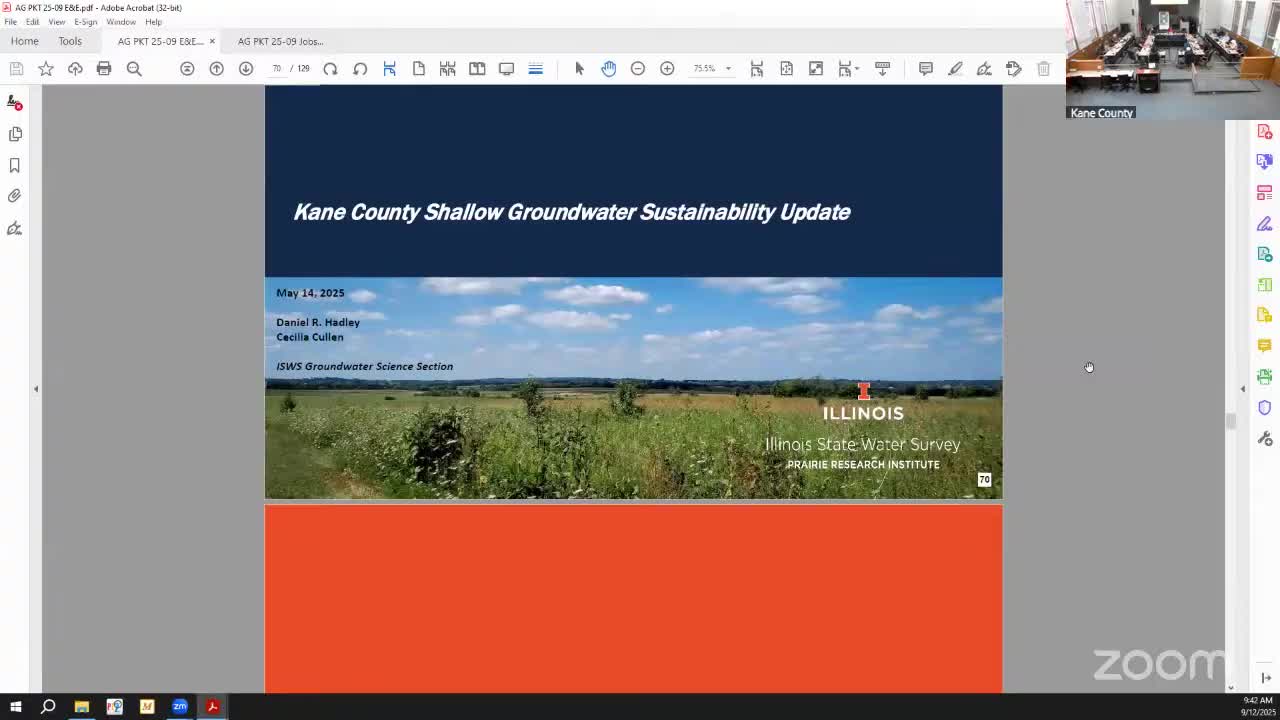
Summary
An Illinois State Water Survey analysis presented to Kane County found Mill Creek's shallow groundwater most severely affected by pumpage, identified concerns about chloride (road-salt) concentrations and reported calibration gaps where the model underestimates peak chloride readings in some Aurora wells.
KANE COUNTY, Ill. ' County staff briefed the Energy and Environmental Committee on Sept. 12 about an ongoing shallow groundwater sustainability study by the Illinois State Water Survey that identifies Mill Creek as the county's most stressed shallow-aquifer watershed and flags calibration gaps in chloride modeling for some Aurora wells.
Jody Wolnick, a county environmental staff member presenting interim results, said the Illinois State Water Survey has installed monitoring wells in northern Kane County, compiled more than 500 chloride observations and is calibrating models that estimate baseflow contributions from groundwater to area creeks.
"Sustainable usage in our shallow groundwater varies by subwatershed, with Mill Creek the most severely impacted," Wolnick said, adding that Mill Creek showed an 80'to'84 percent drop in base flow compared with predevelopment conditions in earlier reports. (Quote attributed to Jody Wolnick, Kane County environmental staff.)
Wolnick told the committee the study integrates municipal utility interviews, measured streamflow and groundwater chemistry. In some watersheds, treated-wastewater discharges (effluent) partially offset baseflow loss; in others, notably Mill Creek, those effluent contributions are minimal and pumpage has reduced baseflow substantially.
On chloride, Wolnick reported that the team assembled 502 chloride observations from county communities and state databases. The study's model reproduces lower chloride concentrations well but currently underestimates the high chloride "peaks" recorded in certain Aurora wells, she said. The Environmental Protection Agency's secondary chloride guidance of 250 milligrams per liter serves as a reference point; the county's interest is in locations where chloride approaches or exceeds that level because high chloride affects taste, plumbing and aquatic life.
"We had to input land-use changes to model chloride loadings; road salt is the primary anthropogenic source where the highest chloride concentrations appear," Wolnick said. "The model is being refined because high observed peaks are not yet matched well by the simulation." (Quote attributed to Jody Wolnick.)
Committee members asked whether sampling methods were reliable; Wolnick said the sampling is correct and that the discrepancy likely stems from model averaging that smooths short-term peaks. She said the Illinois State Water Survey is working on improved calibration and sensitivity to capture high-event chloride spikes.
Wolnick said a real-time monitoring network of shallow wells has been installed and a phase two will add wells in Hampshire and Carpentersville this fall. The county plans to meet again with the State Water Survey in November and expects a final report thereafter.
Committee members raised planning and policy questions: how future development should be managed where shallow aquifers are stressed, how chloride sources can be better managed (winter road-salt practices were identified as the largest controllable source), and whether stress on deep aquifers could drive communities to use the shallower system. Wolnick said the study explores scenarios through 2050, and that many utilities indicated no additional demand on the shallow aquifer beyond current permits, which explains why modeled baseflow stabilizes in some scenarios from 2020 to 2050.
The committee and staff discussed next steps: continued calibration of chloride modeling, mapping of hotspot areas where salting practices should be tightened, expansion of the real-time monitoring network, and county coordination with municipalities on water-supply planning.
The study team emphasized that while average modeled concentrations are useful, the county needs the model to reproduce high chloride events so officials can identify and manage local hotspots where drinking-water quality and stream ecology are most at risk.