
Kane County committee approves $20,000 to expand Batavia residential energy-efficiency program
Get AI-powered insights, summaries, and transcripts
Subscribe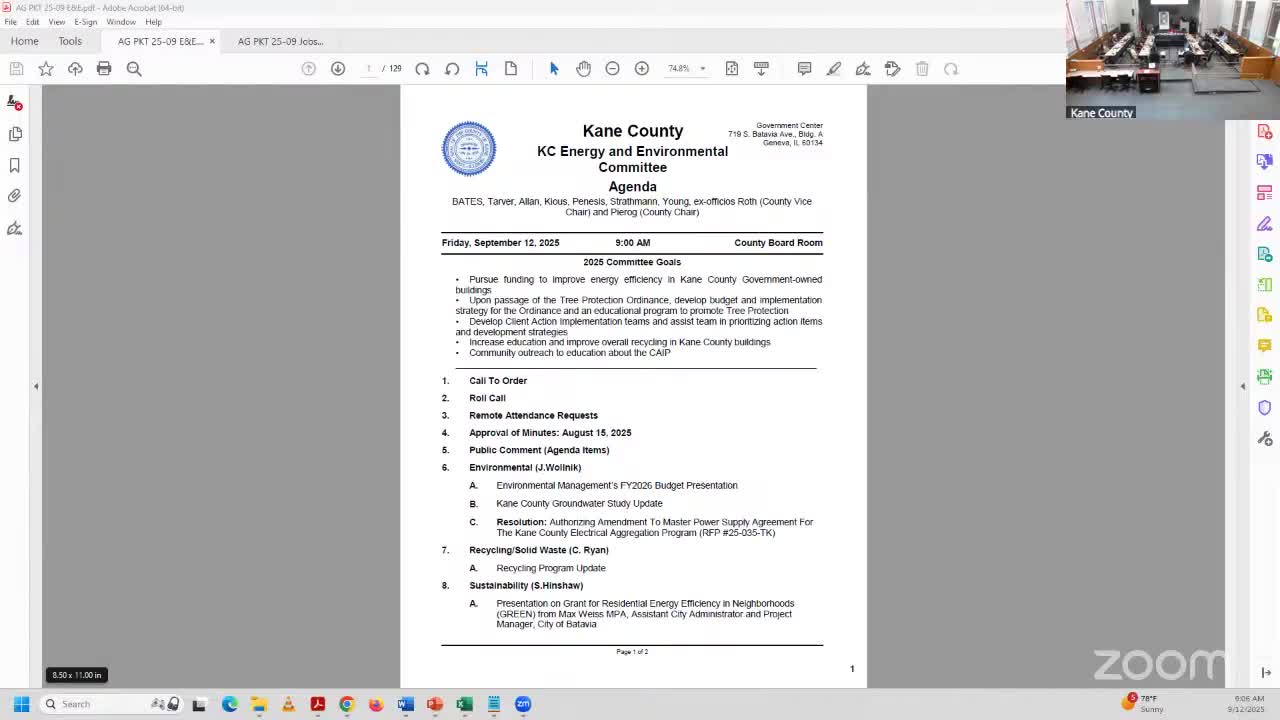
Summary
The Kane County Energy and Environmental Committee voted to allocate $20,000 from the county's electric-aggregation funds to help Batavia expand a residential energy-efficiency program that provides audits and rebates to homeowners.
KANE COUNTY, Ill. ' The Kane County Energy and Environmental Committee on Sept. 12 approved $20,000 to support Batavia's residential energy-efficiency program, a county staff member said during the committee's meeting.
The money will come from the county's electric aggregation program and is intended to supplement Batavia's existing local fund so the city can serve more homes in 2026. The funding resolution passed on a recorded roll call after discussion.
Batavia's program, presented to the committee by Max Weiss, assistant city administrator and project manager for Batavia, uses revenue from a city single-use bag fee to pay for residential energy audits and partial rebates for retrofit work. Weiss said the city allocated $95,000 for year one, which covered audits and rebates for 25 households: 10 designated low-income and 15 non-low-income applicants. Low-income households are eligible for up to $3,000 in rebates and non-low-income households up to $1,000, Weiss said.
"We used King County's area median income to determine low-income eligibility," Weiss said. "We had well over 160 applicants this year, so demand far outpaces availability." (Quote attributed to Max Weiss, assistant city administrator and project manager, City of Batavia.)
Committee members asked how the city would measure results after retrofits. Weiss said the audits are detailed'the contractor typically spends about four hours in a home and produces prescriptive recommendations'and the city plans spot checks after work is complete. Batavia also intends to use aggregate electricity data from its municipal utility to help verify savings in the aggregate, he said.
County staff said the $20,000 contribution would allow Batavia to expand its 2026 target from 25 homes toward a goal of roughly 40 homes, depending on bag-fee revenue and program demand. The county's contribution will go directly to the city to increase the number of residents served; Batavia will continue to administer audits, contractor coordination and rebates under its contractual model.
The committee's memorandum of understanding with Batavia will specify reporting and data-sharing requirements, county staff said, and staff will return to the committee with results as work proceeds.
The resolution carried in committee after a roll call. (Recorded committee vote: Allen Caius: yes; Hennessy: yes; Straffman: yes; David Young: no; Mavis Bates: yes; Roth: yes.)
Supporters said Batavia's program uses an existing local fee to reduce household carbon and energy costs while directing rebates to households that need them most. Members asked staff to ensure the MOU requires household- or project-level verification where feasible so the county and the city can measure actual energy and carbon outcomes.
Batavia's contractor for audits is Sustainability Construction, Weiss said; the city's model separates auditing from installation so homeowners may choose their own contractors or perform eligible work themselves and be reimbursed for materials.
The committee asked county staff to return with the MOU and a reporting schedule once the city and the county attorney finish reviewing the agreement. County staff said audits will continue through the end of the year, with retrofit work rolling into 2026.