
Camarillo council adopts updated Safety Element to reflect new state requirements
Get AI-powered insights, summaries, and transcripts
Subscribe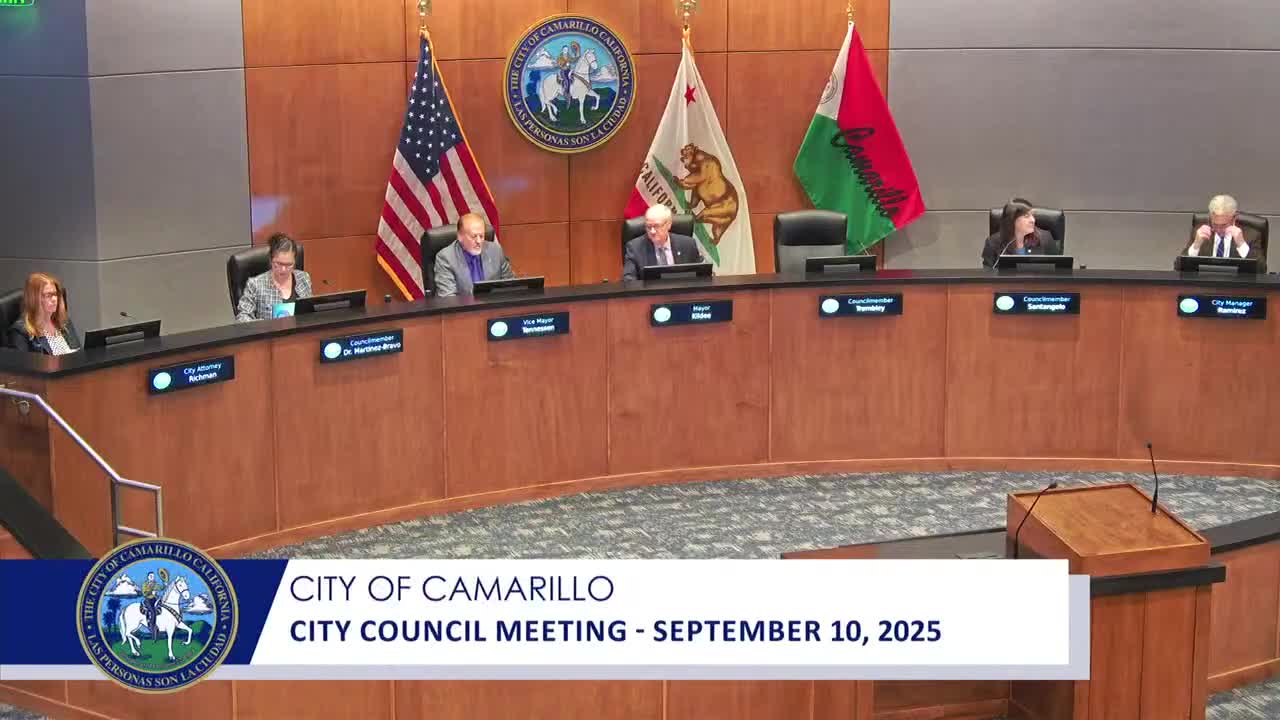
Summary
The Camarillo City Council on Sept. 10 approved staff recommendations to adopt an updated Safety Element for the general plan, incorporating recent state legislation on wildfire mapping, evacuation analysis and other hazards; the vote was 4–0 with one absence.
The Camarillo City Council voted Sept. 10 to adopt the city's updated Safety Element, a revision that incorporates new state requirements on wildfire mapping, evacuation analysis and other hazard planning. "Due to recent state legislation, the safety element has a lot of new requirements," said Lexi Journey of RingCon Consultants, the consultant who presented the update. Journey described changes required by recent government code provisions and Senate Bill 1241, including updated wildfire maps, a vulnerability assessment, evacuation-capacity analysis and an alignment with the multi-jurisdictional hazard mitigation plan. The city’s update reviewed and added policies across multiple topics: wildfire hazard mapping and defensible-space measures; evacuation planning for neighborhoods with fewer than two routes; urban-heat response and drought preparedness; seismic and flooding resilience; emergency response communications and indoor air-quality measures. The update also lists prospective partnerships and grant-implementation pathways, and it reflects recent Local Responsibility Area (LRA) map changes used by Cal Fire. Council action: Vice Mayor Tennyson moved to adopt staff recommendations 1 and 2; a second was recorded and the council approved the recommendations by roll call vote, 4–0, with Council Member Tremblay absent. The clerk recorded votes of Council Member Martinez Bravo: yes; Vice Mayor Tennyson: yes; Council Member Santangelo: yes; Mayor Kildee: yes. The city attorney reported there was no reportable action from the closed-session items earlier in the meeting. Why this matters: the state now requires safety elements to be updated at least every eight years and to include specific wildfire and evacuation analyses; the adopted update is intended to meet those statutory and regulatory expectations and to position the city to seek grants and coordinate with Cal Fire and other regional partners. Clarifying details: the update incorporated a community vulnerability assessment, a wildfire-hazard analysis, an evacuation analysis and Cal Fire review including Board of Forestry input. Policies cited include pursuing wildfire-resistant construction standards, ensuring adequate water supplies for fire protection, expanding defensible space, updating the emergency operations plan, promoting household emergency kits and partnering with the Ventura Regional Fire Safe Council. Next steps: the updated element will be used for planning, grant applications and coordination with regional agencies; additional implementing actions (ordinances, grant applications, capital projects) would be listed separately for council consideration as staff returns with implementation proposals.