
Tenants press council for stronger repair enforcement; City Council approves related housing motion
Get AI-powered insights, summaries, and transcripts
Subscribe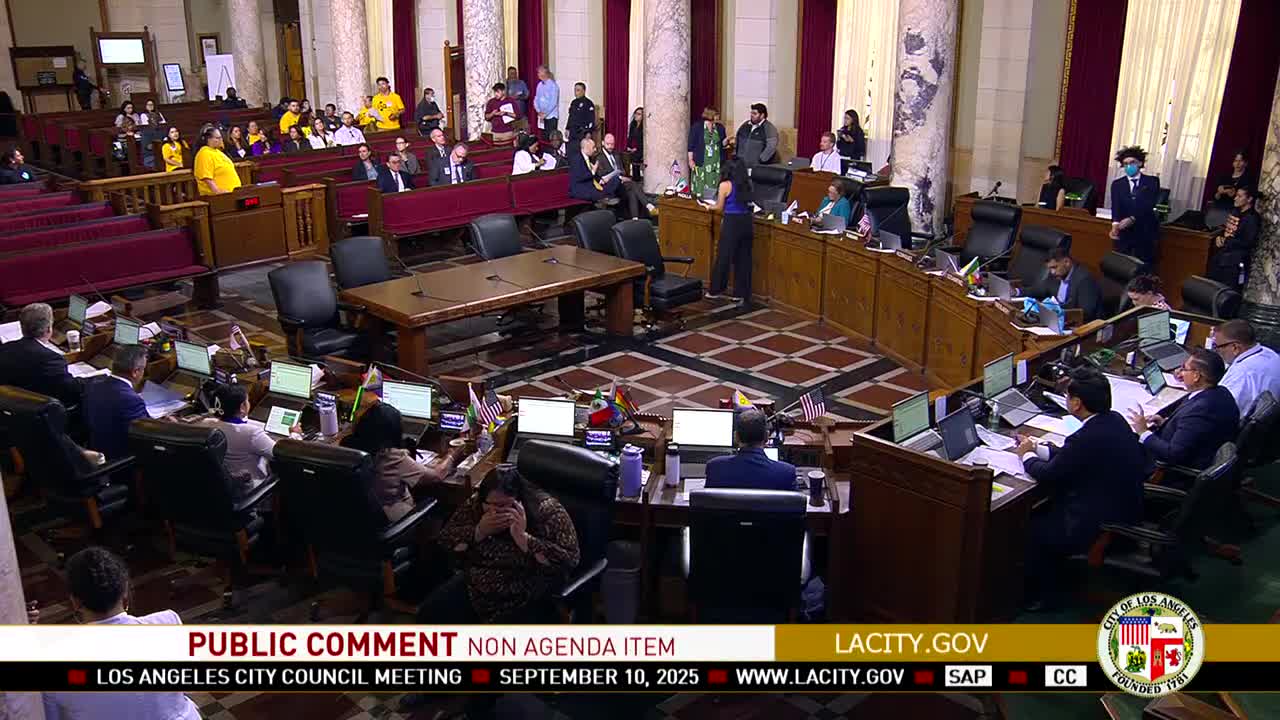
Summary
Multiple public commenters urged the council to strengthen the city’s tenant repair and escrow processes—requesting rent reductions when landlords fail to make repairs, before‑and‑after inspection photos, language access and mold testing—after which council adopted an amended housing motion.
Dozens of public commenters on Sept. 10 urged the Los Angeles City Council to expand tenant protections and strengthen enforcement of the city’s repair and escrow processes. Speakers representing tenant organizers (frequently identified as ACE) asked the council to require inspectors to take before‑and‑after photos of repairs, to create a clear path to activate habitability plans, to permit mold testing by the local health department, to improve language access and appointment coordination, and to allow rent reductions when landlords fail to make required repairs.
Speakers who identified themselves as ACE members included Elva Cuevas Varenas, Justin (ACE member), Diana Dean and Maria Osorio. They repeatedly told the council they supported the recommendations from the Housing and Homelessness Committee but wanted stronger enforcement and additional tenant protections. One speaker summarized demands as asking for “rent reduction if the landlord doesn't make repairs, inspectors taking before and after photos… ensuring language justice, better coordination regarding inspection dates, and also educating the community about the [repair/escrow] process.” Several speakers requested that the Los Angeles Department of Public Health (LDPH) be able to perform mold testing when warranted.
During the meeting the clerk stated that item 16 had been called special and later the council voted on item 16 as amended by motion 16‑A (Hernandez/Bloomfield). The council recorded the item as adopted (roll call recorded 14 ayes on the amended motion). Because public comment for some housing items had been satisfied in committee, the clerk reminded speakers that item 16 was not open for separate public comment but they could address it during general public comment. Several tenants used their general comment time to press for more ambitious enforcement measures than those in the committee recommendations.
Councilmembers and staff have discussed the city’s current repair/escrow process in committee, and public testimony at this meeting emphasized operational fixes: inspectors taking and retaining photographic records of repair conditions, ensuring inspectors who conduct visits have appropriate language abilities, creating explicit instructions for activating habitability plans and enabling mold testing where present. Several speakers also urged that rent increases be constrained when landlords fail to perform repairs; speakers used the shorthand “0‑3” or “cap at 3%” to describe a proposed rent cap that some community groups support.
The council’s formal vote on the housing motion (item 16, amended by 16‑A Hernandez/Bloomfield) passed as shown on the record. Public commenters and housing advocates said they plan to work with councilmembers and city departments to press for additional operational changes beyond the committee recommendations, including explicit photo documentation practices and clearer authority for health‑department testing.
What happened next: Item 16 was considered with an amendment and passed as amended. Public commenters asked the council to pursue additional implementation and enforcement steps with the departments responsible for inspections and habitability enforcement.