
Residents press for enforcement as Glens Falls tests automated speed equipment at Crandall; council vote required to ticket
Get AI-powered insights, summaries, and transcripts
Subscribe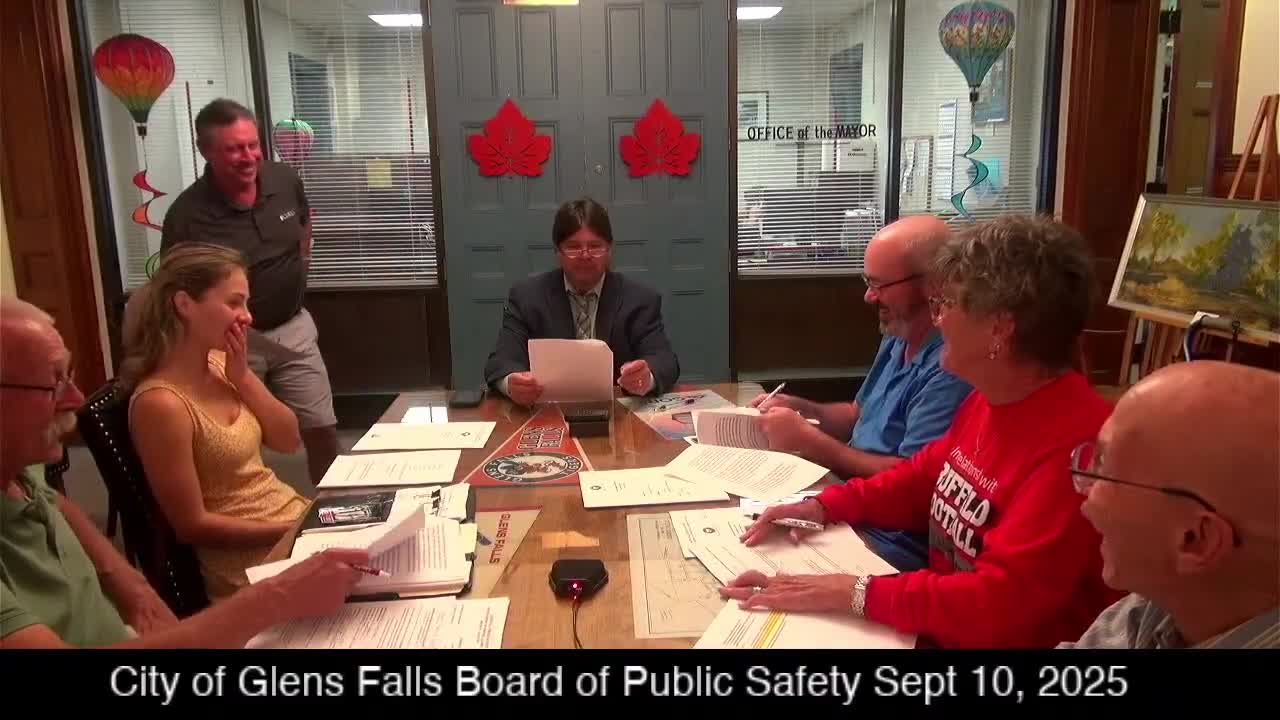
Summary
Residents urged the Board of Public Safety to act after repeated near-misses and children playing near Crandall and Lincoln streets. Mayor and police said the city has spent about $250,000 on automated speed equipment now in testing; tickets would require a change in city code and a council public hearing.
A resident told the Glens Falls Board of Public Safety on Sept. 10 that drivers routinely run stop signs and speed through the Crandall and Lincoln streets area, putting children at risk and prompting calls for more enforcement. “We have cars that just repeatedly speed and don't even touch the brakes when we put a stop sign,” the resident said during the board’s public-comment period.
The concern came as Mayor (City of Glens Falls) and police officials described new automated enforcement equipment the city has purchased and begun testing. The mayor said the city “spent $250,000 on equipment” intended to capture license plates and speeds and that the device was being tested near Crandall Pond.
The testing is part of a multistep process the board said would lead to automated enforcement only after the common council adopts the required local code change. “We have to then it'll go to the council. There'll be a public hearing,” the mayor said, adding that enforcement — ticketing rather than just warning — would follow only if council members approve an ordinance. The mayor also said the city used American Rescue Plan Act (ARPA) funds for the purchase.
Why it matters: Residents said the stretch is a frequent cut-through for motorists and commercial trucks, and schoolchildren play nearby, making the question of how to slow traffic a safety issue for neighborhood families.
Board discussion and next steps: Police leaders described how the equipment works in testing: it records a vehicle’s speed, plate and an associated photo and retains recordings for investigation. Chief Smith, chief of police, told the board the department is still configuring software and policies and will present recommendations to the board and the common council about how data will be used and what violation thresholds should trigger warnings or tickets.
Chief Smith said the department is not using face-recognition features for this deployment and that live monitoring is not being staffed; recorded footage would be retained for 30 days for investigative use. “The cameras we're talking about… it's recording it for 30 days,” Chief Smith said. He also noted that the cameras are capable of additional features but said those capabilities would not be used for enforcement.
Legal, privacy and enforcement questions: Board members and the chief acknowledged potential legal challenges. The mayor told the board the city attorney, Karen Judd, will advise on statutory and local-code implications and that a public hearing at the common council would be required before automated ticketing begins. The mayor also said staff expect opponents to object to enforcement on privacy or revenue grounds once tickets are issued.
What the city plans to propose: The mayor told the board he anticipates recommending a threshold for ticketing — described in general terms at the meeting as drivers traveling about 10–12 mph over the posted limit — and that the council will decide whether warnings or fines apply. The posted speed limit in the discussed neighborhoods is 30 mph, a board member noted during public comment.
Public reaction and enforcement now: Residents urged an increased temporary police presence and targeted ticketing while the automated system is tested. Board members said patrol enforcement will continue in parallel. The mayor said the city has been issuing tickets in hot‑spot neighborhoods and will continue to do so while the automated system is evaluated.
What remains unresolved: The board has not taken a formal vote to adopt an enforcement policy for the new equipment; tickets will not be issued from the system until the council enacts the local code amendment and the board adopts a recommended policy. The city attorney will review state law and local code to support the council’s consideration.
Ending: City officials said they will return to future meetings with draft language, recommended thresholds and a report on the testing at Crandall Pond so the board and the public can evaluate enforcement options before any tickets are issued.