
Seminole County approves tentative $1.215 billion budget and 0.5‑mill increase to general millage
Get AI-powered insights, summaries, and transcripts
Subscribe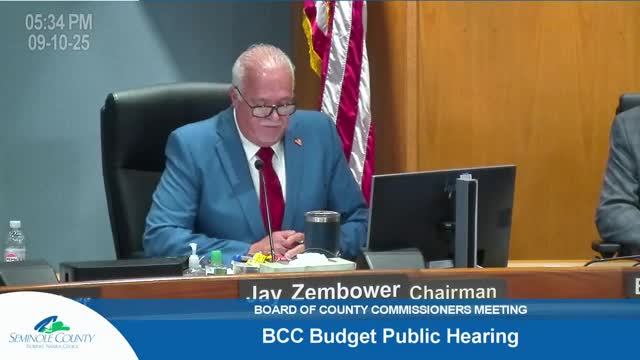
Summary
The Seminole County Board of County Commissioners on Sept. 10 adopted a tentative FY2026 budget of $1,215,087,959 and set the countywide millage at 5.3751 mills, a 0.5‑mill increase the county says is needed to sustain public safety, transportation, stormwater and parks; the vote was unanimous and a final hearing is set for Sept. 23.
The Seminole County Board of County Commissioners on Sept. 10 adopted a tentative fiscal year 2026 budget of $1,215,087,959 and set the countywide millage at 5.3751 mills — a 0.5‑mill increase over the prior year — after a public hearing and presentations from county staff. The board voted unanimously to approve the tentative millage and the tentative budget; a final public hearing is scheduled for Sept. 23 at 5:30 p.m. in the same chambers. County Manager Gray told the chamber that the hearings were required by Florida law and that “this adjustment was not made lightly.”
County staff said the tentative plan is intended to preserve core services and shore up reserves. Timothy Jeks, Management and Budget director, told the commissioners that “the FY 26 tentative budget is balanced with revenues and expenditures totaling $1,200,000,000” and then presented line‑item adjustments and revenue changes that produced the $1.215 billion tentative total. Jeks read the tentative millage rates into the record: the general countywide millage of 5.3751 mills is 16.42% above the rollback rate of 4.6168 mills; the fire/rescue MSTU is 2.7649 mills (5.43% above its rollback); the Unincorporated Road MSTU is 0.1107 mills (5.33% above its rollback); the tentative aggregate millage for all BCC taxing districts is 7.3663 mills (12.7% over the aggregate rollback). The fire and road MSTU rates remain unchanged from FY25.
Staff cited several revenue and expenditure adjustments. Key revenue changes included a $3.0 million increase in ad valorem revenue (budgeted at 96% of final taxable values) and a $3.1 million increase associated with a tourism improvement district approved this summer; reductions included $3.3 million in public service tax and $1.4 million in local option fuel tax to reflect partial‑year collections. On the expenditure side, staff flagged a $5.6 million reduction tied to a partial‑year change in fixed‑route bus service and a related $5.5 million increase to fund a full year of microtransit service; water and sewer debt service falls by $2.1 million after a recent refunding; the sheriff reduced his budget request by $900,000; and countywide reserves were reduced, with staff noting an $11.3 million reduction in countywide reserves overall. County staff projected general fund reserves at about $69,000,000, roughly 18% of operating expenses and revenues.
Supporters at the podium said the increase would protect services and tourism funding. Leslie Grubel, speaking for the League of Women Voters of Seminole County, said the organization ‘‘proudly supports passage of the proposed budget’’ to preserve libraries, parks and public safety. Richard Glover, chief executive officer of the Central Florida Zoo and Botanical Gardens, warned that “if the millage adjustment does not happen, the county would not be able to pay for all the services its residents expect,” and he said loss of the county’s tourism development tax could force attractions to scale back. Multiple tourism and cultural leaders, including Central Florida Zoo trustees, told commissioners that tourism development tax (TDT) revenues support museums, attractions and marketing that bring visitors and sales tax dollars into the county.
Opponents questioned timing and affordability, and they pointed to recent tax changes. Several speakers, including George Sillery and Tom Ehler, noted that the county recently raised its local gas tax and utility tax and that voters approved a county‑wide one‑cent sales tax; they argued those actions plus rising assessed values make another millage increase untenable for many homeowners. Speakers representing neighborhoods and senior or fixed‑income households said an added 0.5 mill would disproportionately hit people on fixed incomes; others asked why the county was increasing reserves while seeking new revenue. A number of residents urged the commission to seek further cuts, pursue municipal cost‑sharing with the county’s seven cities, or fund park projects via MSBUs where beneficiaries are local.
Commissioners discussed options and asked staff for follow‑up. Commissioner Constantine said he was “still looking for every penny of savings” and pledged continued work with staff and constitutional officers to find cuts before the final hearing. Commissioner Lockhart emphasized disaster preparedness and state legislation as central drivers of reserve needs, saying the county ‘‘do[es] not have a firm understanding of what support mechanisms our local communities will have in case of a hurricane or some other disaster’’ and listing recent county disaster‑related expenditures as context for reserves planning. Commissioners asked staff to compile and respond to public comments and to continue seeking efficiencies; several members said they would consider reductions prior to the final vote.
Formal action taken: the board adopted the FY26 tentative millage rates as presented and adopted the tentative FY26 budget as adjusted. The motions passed unanimously. The board reminded residents the vote is tentative and that the second and final public hearing on adoption of millage and budget will be held Sept. 23 at 5:30 p.m. in the Commission Chambers.
The hearing record and staff presentations list numerous program priorities included in the tentative budget: continued funding for the Seminole County Sheriff’s Office and fire/EMS operations; a new county‑funded microtransit service intended to reduce fixed‑route costs; stormwater/drainage improvements (noted for Midway); redevelopment and park projects at Rolling Hills Community Park and Deer Run; and planning and design for the Rosenwald Community Center project on the former Rosenwald school site in East Altamont. Residents and organizational leaders told commissioners those investments sustain property values and local businesses; critics said some projects should be postponed or locally funded. The board’s staff committed to provide additional detail and to consider further reductions before the final hearing.