
Arroyo Grande council orders master plan work, delays decision on converting tennis courts for pickleball
Get AI-powered insights, summaries, and transcripts
Subscribe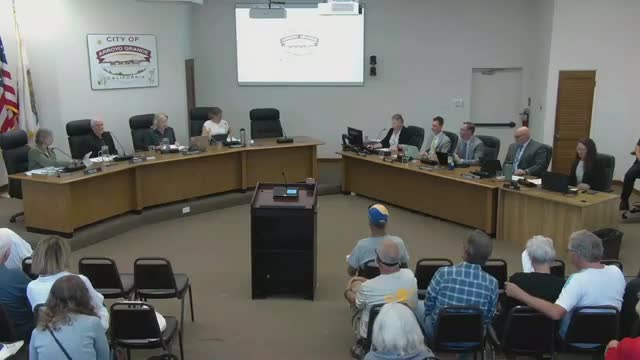
Summary
City council directed staff to proceed with a master plan and infrastructure priorities for the SOTA Sports Complex and Elm Street Park, but deferred action on converting tennis courts to dedicated pickleball courts pending additional community outreach and survey data.
Arroyo Grande — The City Council on Sept. 9 authorized staff to move forward with a master plan for the 18‑acre SOTA Sports Complex and adjacent Elm Street Park, including infrastructure priorities such as restrooms, lighting, safe spectator areas and pedestrian connections, but stopped short of approving a permanent conversion of tennis courts for pickleball play.
The master plan work approved by the council will proceed with community outreach and targeted engagement, and staff was directed to treat parking as an optimization issue rather than simply adding more spaces immediately. Sheridan Bolkin, the city’s director of recreation services, told the council the master plan was funded at $275,000 in the current capital improvement program and is scheduled to begin in October 2025 with a target for completion by June 30, 2026. Bolkin also told the council staff’s recommendation was “to defer installation until the master plan process is complete” for any multiuse court conversions so improvements are coordinated as part of a larger plan rather than piecemealed.
Why it matters: the SOTA complex and Elm Street Park serve dense neighborhoods and regional users for softball, soccer, youth sports, dog‑park users and court players. The council’s direction seeks to balance competing demands — tennis players and organized leagues that require four dedicated tennis courts, and a rapidly growing pickleball community that says current courts have long waits — while protecting limited park acreage and addressing restroom and staffing needs.
Most of the evening’s public comment focused on whether to convert two tennis courts into multiuse or dedicated pickleball courts. Residents who said they play tennis and run USTA and league programs warned that dual‑striping or multiuse lines make courts unusable for sanctioned tennis matches and for teaching young players. “Converting…renders them useless for tennis. You will never see tennis players on a multiuse court,” said Susan Ritchie Broucher, a regular public‑courts tennis player. Several speakers noted that four contiguous tennis courts are required to host league and USTA matches.
Pickleball players and volunteers urged interim solutions and new courts. Ronnie Glick, a volunteer with the pickleball club, asked the council for an interim fix and said the club had over 220 active members this year and was already contributing fees and volunteer work. “We cannot wait 3 to 5 years for this city to put new tennis courts, new pickleball courts at this complex,” Glick said during public comment. Staff estimated the striping and portable nets to create four multiuse courts on two tennis courts would cost roughly $12,000; Bolkin cautioned that temporary conversions can create operational issues including increased restroom and parking demand.
Council discussion reflected the divided public comment. Several council members emphasized collecting better usage data and targeted outreach to nearby residents before making an enduring change that could remove USTA‑sanctioned tennis capacity. Others said the city should prioritize immediate infrastructure needs — notably permanent restrooms and a recreation office or small facility — that would support both current programs and any future surfacing changes. Assistant City Manager and Public Works Director Bill Robeson told the council that adding a new hard‑surfaced court (single court footprint) generally costs in the range of roughly $100,000 to $300,000 depending on surfacing, fencing and lighting.
Formal actions and next steps: the council voted to proceed with the master plan and the targeted community engagement approach, asked staff to include restroom, spectator safety, lighting upgrades and pedestrian connectivity among infrastructure priorities, and to optimize existing parking as part of planning. The council also directed staff to return with community survey results and engagement findings before making any decision to convert existing tennis courts to pickleball. A later motion to convert one tennis court into dedicated pickleball courts was proposed during the meeting but failed to achieve a majority; the council instead voted to defer final action on court conversions pending the outreach and survey.
What happens next: staff will begin the master plan process in October 2025, carry out the council‑directed outreach and return with findings and prioritized implementation steps. The council asked staff to include the recommended CEQA analysis with future recommendations. Any permanent change to court configuration will be brought back to the council with the survey results, infrastructure options, cost estimates and staff recommendations.
Public comment and safety concerns dominated the debate. Speakers raised parking pressure around the complex, the risk that dual striping makes tennis play unsafe or unclear in wet conditions, and the difference in game length and participant turnover between the sports — pickleball games often allow rapid turnover and many waiting players, while tennis matches are longer and require contiguous courts for league play. Several commenters suggested building new, dedicated pickleball courts elsewhere in the city rather than converting existing tennis courts used for instruction and competition.
The council’s direction leaves the complex’s long‑range vision open while moving forward on prioritized infrastructure, and it commits the city to gather clearer usage data and neighborhood input before making irreversible changes to court layout.