Get Full Government Meeting Transcripts, Videos, & Alerts Forever!
Get email alerts on the Board Confidentiality topic
No spam. Unsubscribe anytime.
School board studies limits of executive‑session confidentiality and applicability of 'Silence No More' law
Summary
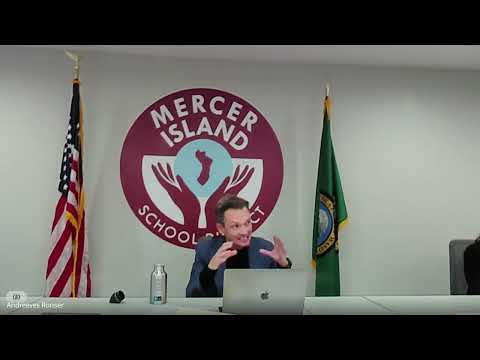
The Mercer Island School District Board of Directors held a study session to review whether board members may be treated as employees for purposes of Washington—s "Silence No More" law and to clarify the legal scope of executive‑session confidentiality after public concerns were raised about statements about another director.
The Mercer Island School District Board of Directors held a study session to review allegations that board members had made public statements about a fellow director and to clarify what information discussed in executive session must remain confidential. The board also asked outside counsel about whether Washington—s so‑called "Silence No More" law applies to elected board members.
Board members said they wanted legal clarity after weeks of public comment and organizer emails prompted questions about confidentiality, defamation and parental notification requirements. "This is a study session, not a hearing," outside counsel Charles Leach told the board, adding the meeting was meant to "promote a conversation." The session brought multiple board members back to a single question: when is information discussed in executive session protected from disclosure?
The legal nut of the discussion was whether the 2025 state protections commonly called the Silence No More Act apply to elected board members and whether public records previously released mean the information was never confidential. "Silence No More Act applies to employees," Leach said, explaining it addresses employer nondisclosure and nondisparagement provisions and that "it does not apply in the context of board decision making or board action" because elected directors are not employees of the district. He summarized the consequence plainly: "The district would not be in a position to enforce that." Director Glowitz, who asked for the study session, pushed back that the statute and related attorney general opinions have sometimes treated elected officials as employees for some purposes and wanted the board to seek a written legal opinion on the issue.
Board members pressed two related legal questions: the difference between confidentiality for matters discussed in executive session under the Open Public Meetings Act (OPMA), and exemptions to the Public Records Act (PRA) such as FERPA or other statutory exemptions. "Just because it's discussed in an executive session, it's not rendered confidential," Leach said, but he also cautioned that many PRA exemptions and other statutes can make records or portions of records nonpublic. "It doesn't just because you produce a record related to something doesn't result in a waiver of the protections of executive session," he added.
Several directors described their training and practice as treating executive session discussions as confidential. "When I joined the board, anything discussed in executive session, you never read the word of outside of executive session," one director said. Other directors said lack of a clear district position after 20 months of public questions had eroded trust and urged the district to clarify policy on what is confidential, especially for allegations involving misconduct.
Board members also discussed RCW citations raised in the session and recent state law changes. Speakers referenced RCW 28A 3 21 60 (parental notification for alleged misconduct by school employees), the Silence No More Act (as discussed in the meeting), RCW 42.23.070 concerning disclosure of executive session information by municipal officers, the Public Records Act, OPMA, and FERPA. Leach noted the practical path for the district when confidentiality is disputed: administrative handling of public‑records requests and, when necessary, seeking judicial protection for specific records.
No formal action was taken during the study session. Board members said they wanted follow‑up: a clearer written statement of district practice about what is and is not confidential when allegations of employee misconduct arise; consideration of whether to request a formal written opinion on the Silence No More statute—s applicability to elected directors; and better guidance to staff and the board on handling public records and communications stemming from executive sessions.
The discussion signaled continued divisions among directors about disclosure and trust, but attendees agreed on next steps: obtain clarifying legal advice and consider drafting a district position or policy so future executive sessions can be used without undermining student privacy or board deliberations. "We need to determine what we want to learn and know about this," one director said, framing the follow‑up as fact finding rather than a punitive exercise.