Get Full Government Meeting Transcripts, Videos, & Alerts Forever!
Get email alerts on the K 12 Assessment topic
No spam. Unsubscribe anytime.
Palm Springs Unified presents fall STAR benchmark; district outlines targeted reading and math interventions
Summary
At the Sept. 9 Palm Springs Unified School District Board of Education meeting, district staff presented fall Renaissance STAR benchmark results showing 32.8% of students meeting or exceeding the grade-level reading benchmark and outlined interventions for English learners, students with disabilities and other groups.
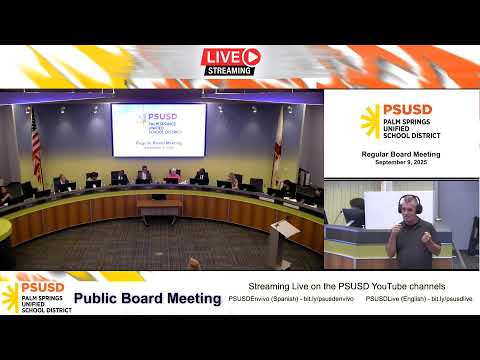
Palm Springs, Calif. — The Palm Springs Unified School District Board of Education on Sept. 9 reviewed early fall Renaissance STAR benchmark results and district plans to address persistent achievement gaps in reading and math.
The district reported that 32.8% of students scored at the “met or exceeded” level on the fall STAR reading benchmark, 21.9% were at “nearly met,” and 45.3% at “not met.” Mark Arnold, the district’s executive director of student learning, told the board the STAR diagnostic is “kind of that indicator of how well students may be doing on the CAASPP assessment.”
The benchmark is a computer‑adaptive diagnostic administered in the fall, winter and spring to monitor progress and to provide indicators that correlate with the California Assessment of Student Performance and Progress (CAASPP), district staff said. Arnold and staff emphasized that results in early September reflect end‑of‑year standards and that students have the school year to show growth if interventions are implemented.
Why it matters: the STAR benchmark is used to guide instruction and predict CAASPP outcomes. District leaders said the fall snapshot shows notable achievement gaps for English learners (ELs) and students with disabilities and that the district will focus resources at those groups while continuing districtwide strategies.
What the district will do: staff described a combination of universal and targeted actions already in place or planned: - Continued LETRS professional development for reading instruction and a districtwide reading professional development day scheduled for Oct. 13 focused on reading instruction and secondary-level strategies. - Literacy coaches at 12 sites (state‑funded where unduplicated pupil counts meet grant criteria) and instructional coaches at all sites to support tier‑1 instruction and data‑driven small‑group work. - Site reading intervention teachers and paraprofessionals for targeted support; district staff noted some sites hire additional paras to expand intervention. - Adoption and rollout of a new reading screener this year; staff said rollout is ongoing and they are considering additional devices/materials to ease testing. - Expanded integrated and designated ELD (English language development) practices and additional ELD course sections at secondary grades for students at risk of long‑term EL status (LTEL). - Expanded co‑teaching and para‑supported instruction and alignment of professional development across general and special education for students with disabilities, plus use of Universal Design for Learning (UDL) strategies in classrooms.
Board members asked for longitudinal comparisons and disaggregated views. One board member pressed for clearer reporting on African American student outcomes and requested year‑over‑year growth figures; staff said they would provide fall‑to‑midyear comparisons in the next benchmark report and could include prior‑year comparisons.
On timing: staff said the board will review second‑benchmark results in February and the third benchmark in June; the district also plans to present preliminary correlations between STAR and CAASPP results at an upcoming board meeting.
The presentation included discussion of math results as well: district staff described math as showing lower overall benchmark percentages than reading and attributed part of that to the linear progression of math standards (new concepts introduced at each grade). The district noted work with the Irvine Math Project, a recent Reveal math adoption, summer curriculum refinement and plans for building “thinking classrooms” in professional development.
District staff and board members emphasized that the STAR results are a starting point for targeting instruction and that the district will return with growth measures and further disaggregated data. Ending: staff committed to supplying the board with requested disaggregations and year‑to‑date growth figures on a Friday information delivery as follow up.