Get Full Government Meeting Transcripts, Videos, & Alerts Forever!
Get email alerts on the Budget topic
No spam. Unsubscribe anytime.
Escambia school leaders warn falling enrollment and voucher flow-throughs shrank general-fund cushion to about 5.5%
Summary
Board members and the superintendent discussed a lower-than-expected fund balance, a drop in traditional public-school enrollment and voucher funding that appears in district budgets but flows to private providers, and possible staffing and facility changes to avoid a budget shortfall.
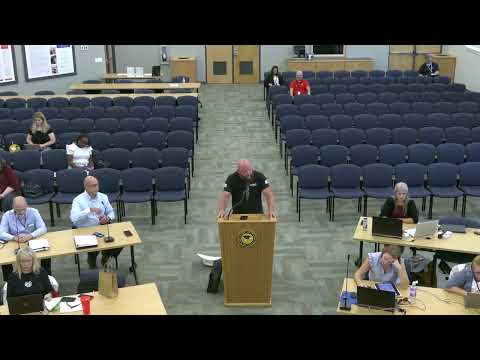
Escambia County School Board members and Superintendent Leonard discussed the district’s financial condition during a Sept. 11 special meeting, focusing on a decline in traditional student enrollment, a fund balance that dropped to about 5.5% of the general fund and the way state voucher funding appears in district budgets even when the dollars flow to private schools.
Board members raised the issue after the board approved a resolution amending the 2023–24 and 2024–25 district budget and then accepted the superintendent’s annual financial report. Board Member Adams noted a decrease in the district’s “financial condition ratio” from 9.7% to about 5.5% and urged monthly reporting that would show how internal transfers and reserve changes affect the overall picture.
Why it matters: a slimmer fund balance reduces the district’s flexibility to address unexpected costs and to fund salary or program changes without drawing reserves. Board members said they want earlier, clearer updates so the board can consider adjustments before late‑year transfers or one‑time accounting moves are needed.
Superintendent Leonard and staff told the board that the apparent stability of the budget is obscured by the state funding formula and voucher flow-throughs. The superintendent explained that state voucher payments are included in the district’s overall budget figures even when the money ultimately goes to charter or private providers; as a result, the district’s actual controllable funds shrink with lower traditional school enrollment even when the top‑line number looks similar. Board members said the district has identified roughly 277–300 students who remain in district classrooms while holding vouchers, creating a timing and revenue mismatch the district is still attempting to resolve with the state.
The superintendent described some of the steps already taken to reduce costs, including staffing reallocations, continued review of contracted services and using capital millage to cover eligible costs such as transportation. He said transportation routes are operating on four tiers with fewer drivers and that some positions were absorbed into staffing allocations rather than being eliminated outright.
Board members and staff discussed potential next steps if the enrollment trend and voucher outflow continue: hiring freezes, a review of contracted services, and longer‑range options such as consolidation or repurposing of under‑capacity schools. Board Member Petzko and other members said closures and consolidations are possible tools but cautioned that such steps would take 12–18 months to implement and must be done thoughtfully to avoid creating vacant buildings that could be taken over by others.
Formal actions: the board moved and approved a resolution to amend the 2023–24 and 2024–25 district school budget and voted, 5–0, to accept the superintendent’s annual financial report. Several members signaled they plan to return for follow‑up workshops requesting monthly snapshots of the financial condition ratio and a simple dashboard showing major transfers.
Next steps: board members asked staff to prepare more frequent, top‑level reports (including a consistent financial condition ratio and a fund‑balance chart) and to bring longer‑range options — such as consolidation or building repurposing plans — to future workshops so the board can consider timing and community impact before making final decisions.