Get Full Government Meeting Transcripts, Videos, & Alerts Forever!
Get email alerts on the Water Rates topic
No spam. Unsubscribe anytime.
Council adopts 4‑year plan to equalize water consumption rates; manager outlines $20–$30M pipe replacement need
Summary
Council unanimously adopted a four‑year plan to phase in uniform water consumption rates and adjust base charges; borough manager described aging water mains, acoustic leak detection pilot and an estimated $20–$30 million to replace roughly 13 miles of pipe.
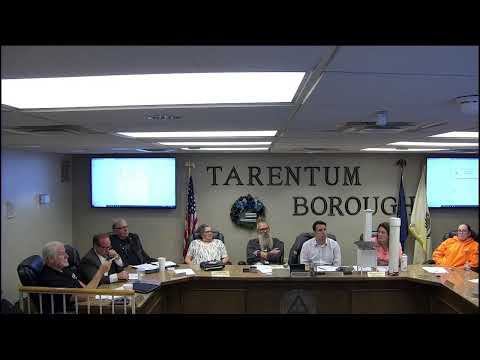
Tarentum Borough Council adopted a resolution establishing a four‑year plan to phase in uniform water consumption rates on a schedule the borough manager said will preserve predictability for residents while raising commercial and industrial rates toward parity. Borough Manager Dwight Bodorf recommended freezing the residential (5/8-inch) rate for four years while incrementally increasing larger-meter and commercial rates so that, by 2029, all customers pay the same per‑thousand‑gallon consumption price. He told council that, based on 2024 data, resident households paid about $13.95 per thousand gallons while a six‑inch industrial meter paid about $8.83 — a 36% built‑in discount that the manager said discourages conservation and shifts costs onto residents. Why it matters: Bodorf said Tarentum’s distribution pipes are reaching the end of a roughly 100‑year lifecycle; engineers and the DEP estimate replacing about 13 miles of pipe will cost between $20 million and $30 million. Bodorf described a targeted approach: rotate acoustic leak detectors by ward to locate clusters of small and medium leaks, use pressure meters to map zones and prioritize line segments. He cited Davidson and several other streets as immediate priorities and gave an example replacement cost of about $620,000 for a 1,400‑foot segment. Council action: Council lawmakers moved and passed the water‑rate resolution unanimously (7–0). The adoption was recorded as Resolution 25‑17 establishing 2026 water rates and a four‑year phase‑in plan. Bodorf noted the borough’s contract with East Deer (the wholesale supplier) runs until 2032 and the borough must coordinate changes with contracted parties; he also referenced the American Water Association’s guidance on meter‑equivalency for setting base charges. Implementation and caveats: Bodorf recommended earmarking any new water revenue for pipe replacement only. He also said regional options — a shared water authority or other forms of regionalization — remain on the table but are long‑term discussions; short‑term, the manager proposed incremental rate adjustments and capital planning to reduce the likelihood of sudden, large increases.