Get Full Government Meeting Transcripts, Videos, & Alerts Forever!
Get email alerts on the Landfill Earth Removal topic
No spam. Unsubscribe anytime.
Peabody council continues hearing on ReWorld landfill earth‑removal after blasting, truck‑route and departmental‑review concerns
Summary
Peabody City Council continued a public hearing on Sept. 11 for ReWorld Peabody Inc.'s proposed removal of about 91,700 cubic yards of overburden and bedrock for a planned Phase 4 landfill cell, after councilors asked for a blasting schedule, truck‑route limits and formal responses from the fire department and Department of Public Services.
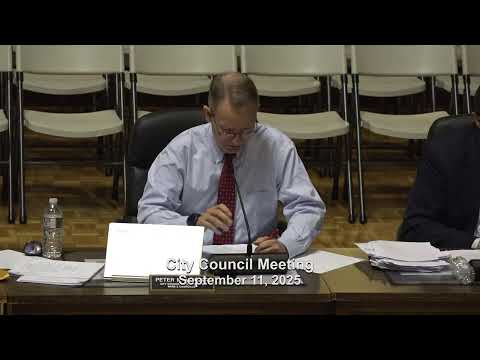
The Peabody City Council on Sept. 11 continued a public hearing on an earth‑removal permit for the Peabody ash monofill, asking ReWorld Peabody Inc. and its consultants to provide a blasting schedule, confirm truck‑routes and seek formal departmental reviews before the council takes final action.
The permit application seeks local approval to remove roughly 91,700 cubic yards of overburden and bedrock to construct a proposed Phase 4 landfill cell at the site off Forest Street. Councilors said the project requires clearer detail on blasting timing and safety, truck volumes and engineered review from the Department of Public Services and the Fire Department.
The hearing matters because the quarrying and blasting will occur near commercial properties and, councilors said, nearer some residences than in earlier phases. Councilor comments repeatedly flagged the need for: a specific blasting schedule and pre‑blast surveys, departmental technical memos (DPW/DPS and Fire), confirmation of buffer setbacks to wetlands and wells, and a clear truck‑route plan that avoids Lynnfield Street and Jubilee Drive residential sections. Councilor Gamache moved to continue the hearing to Sept. 25 and to request written input from DPS, the fire chief and the conservation commission; the motion carried.
Tighe & Bond engineer Dennis Moran told the council the removal is part of planned construction of Phase 4 and that ReWorld (formerly Covanta) is coordinating with MassDEP, the board of health, planning board and conservation commission. Moran said roughly 410,000 cubic yards have already been removed at the site under prior permits and that most of the material from the current work will be reused on‑site for drainage stone, road base and capping material. He described the landfill construction sequence — drainage stone, double composite liners, pump house and leachate handling — and said MassDEP will perform its own review.
Councilors pressed for more local documentation. Councilor Turco said there was no present blasting schedule and no departmental responses; she said she would not support approval without them. Councilor Higgins asked that the council be provided with seismograph/monitoring plans and an interior/exterior survey plan for structures near the blasting area. Councilor McGinn and others said they were surprised the council had not been given DPW engineering comments and asked that the petitioner supply the presentation slides and additional materials as late communications so staff and the public could review them.
ReWorld regional landfill manager Steve Maloney (present during the hearing) and Dennis Moran said the project will follow previously approved setbacks and that the bulk of blasting work will be outside wetland buffer zones. They said ReWorld performs pre‑blast condition surveys for nearby structures and that a fire department detail has accompanied past blasting. They agreed to provide a more concrete blasting schedule and to work with the city on truck routing. Moran listed the expected local truck routes as Forest Street to Route 1 North, Dearborn Road to Route 1 South, and a route using Jubilee Drive/First Avenue to I‑95/Route 128; he said Lynnfield Street will not be used for outbound loads.
The council also requested written confirmation from the city’s Department of Public Services and the fire chief about required permits, safety conditions and monitoring and asked that the petitioner supply a blast‑monitoring plan and an estimate of truck volumes expected to leave the site. Councilor Gamache said he expected this to be the final phase of the multi‑phase project once state and local approvals are completed.
The council continued the hearing to Sept. 25 and directed staff to request departmental memoranda from DPS (engineering), the fire chief and the conservation commission and to accept the petitioner’s supplemental presentation as late communication so the record is complete before a final vote.