Get Full Government Meeting Transcripts, Videos, & Alerts Forever!
Get email alerts on the Public Art topic
No spam. Unsubscribe anytime.
Presque Valley adopts public-art policies, requires 1% set-aside for large capital projects
Summary
The council approved a townwide public professional art policy and a capital-improvements art policy that directs 1% of CIPs of $500,000 or more toward public art, creates selection and maintenance procedures, and establishes an art review committee.
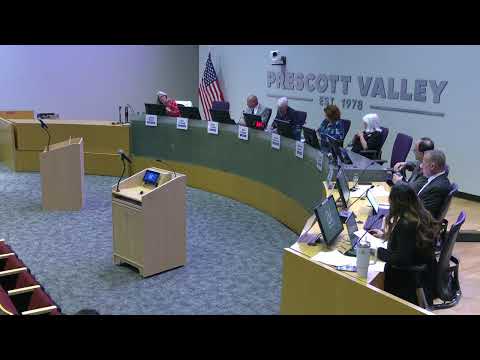
Presque Valley — The Presque Valley Town Council on a unanimous vote adopted two policies to expand the town's public art program, including a capital-improvements provision that sets aside 1% of eligible project budgets for art. The council authorized the mayor to sign Resolution No. 2025-2433 adopting Town Policy 1-13 (Public Professional Art Program) and Resolution No. 2025-2432 adopting Town Policy 1-12 (Capital Improvements Public Art Program).
The public professional art policy, presented by Recreation Manager Elise Bedell, formalizes procedures the town has been using and sets eligibility, selection, maintenance, and removal standards for artwork on town-controlled property. "Prescott Valley does currently have a public art program ... however, it's limited, and we wanted to create a more robust policy to manage this," Bedell said during the presentation.
The capital-improvements policy requires that any capital improvement project (CIP) with an estimated budget of $500,000 or more include an additional 1% allocation for associated artwork, unless the town council grants an exemption. The policy specifies that when multiple funding sources contribute to a project, each source would contribute to the art allocation proportionally to its share of funding, subject to applicable regulations.
Officials said the policies create roles and processes to manage acquisitions and long-term care. The arts and culture coordinator — named in the presentation as Mackenzie Reynolds — will maintain a public art inventory, prepare annual maintenance assessments for inclusion in the budget, coordinate calls to artists, and preside over selection reviews with the parks, arts and recreation commission and implementing departments.
The CIP process described in the policy calls for the implementing department to work with the arts and culture coordinator to define scope, issue artist solicitations, and bring selections to a CIP art review committee. That committee will include representatives from the implementing department, the arts and culture coordinator, at least one parks commissioner, and the town's public works and finance directors.
The town outlined reasons art could be removed from the collection, including safety risks from structural deterioration, excessive maintenance requirements, irreparable damage, security problems, changes in site use or design, or a request by the artist. Bedell said loans must be for at least three months and that donated pieces will be documented and managed under the new policies.
Councilmember Gilbert noted the approach mirrors practices used by larger agencies and state highway projects that incorporate design elements into infrastructure. The council then voted to adopt both resolutions.
The measures take effect according to the resolution process; the policies also direct staff to develop contracts, maintenance plans, and budget recommendations tied to future projects.