Get Full Government Meeting Transcripts, Videos, & Alerts Forever!
Get email alerts on the K 8 School Performance topic
No spam. Unsubscribe anytime.
Liberty Traditional presents preliminary A rating, sets 100% K–8 proficiency goal
Summary
School leaders told the Humboldt Unified School District board that preliminary 2025 data show a district A rating for Liberty Traditional, outlined steps — including Project Momentum and new diagnostics — to reach a goal of 100% K–8 proficiency, and highlighted teacher collaboration and a $13,430.13 kindness fundraiser.
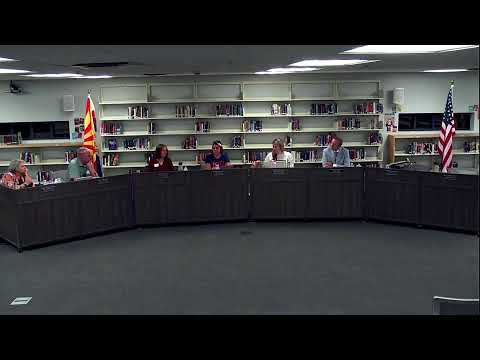
At the Sept. 11 Humboldt Unified School District Governing Board meeting, Liberty Traditional Principal Jamie Stratton and assistant principals Holly Norell and Nick Gratzel presented preliminary 2025 school data, said Liberty had earned a preliminary A rating for 2024–25, and set an ambitious goal that 100% of kindergarten through eighth-grade students reach grade-level proficiency.
The presentation focused on proficiency rather than growth metrics. "Our very first goal is a 100% kindergarten through eighth grade students will achieve grade level proficiency," Stratton told the board. She outlined five action steps that school leaders will use to reach that target, including strengthening Tier 1 instruction through Project Momentum learning intentions and success criteria, administering the Renaissance DNA diagnostic (grades 1–8), identifying students at risk and highly proficient learners, acting in real time when students master skills, and reviewing progress with new action steps by October.
Nut graf: School leaders said the steps aim to convert recent gains into sustained proficiency across grades. Assistant principal Nick Gratzel explained how the state school-grade formula breaks down — 50% growth, 30% proficiency, 10% English-learner performance and the remainder for acceleration/readiness — and said Liberty is prioritizing proficiency because they expect growth to follow.
In support of their strategy, presenters said teacher collaboration has intensified: teachers observe one another, analyze benchmark data in professional learning communities (PLCs), and apply Project Momentum routines in classrooms. Gratzel said the school’s preliminary data show significant jumps in some grades from 2024 to 2025, and he attributed at least part of the improvement to teachers’ implementation of Project Momentum and training on administering state-type assessments.
The presentation included specific school highlights and community activities: a Rocket Science project for seventh-graders, a middle-school trip to Bob Edwards Park, a classroom hatching project, and a fundraising “Kindness Challenge” that raised $13,430.13 districtwide for Liberty. Staff honored classified and volunteer VIPs and recognized teacher Brett Rowe as a teacher-of-the-year award recipient.
Board discussion asked how the school translates the leadership ownership model into student behavior and engagement. Stratton said teachers encourage students to track their progress (example: kindergartners color a rainbow as skills are mastered) and celebrate advances immediately so students do not wait for bench-mark cycles. Several board members praised the presentation and the leadership team’s early focus on proficiency.
Ending: The board did not take a formal vote on Liberty’s plan; the presentation concluded with an invitation for board members to visit the school and review the district data nest and classroom examples of learning intentions and success criteria.