
House hearing lays bare split over roadless rule repeal, timber targets and forest management
Get AI-powered insights, summaries, and transcripts
Subscribe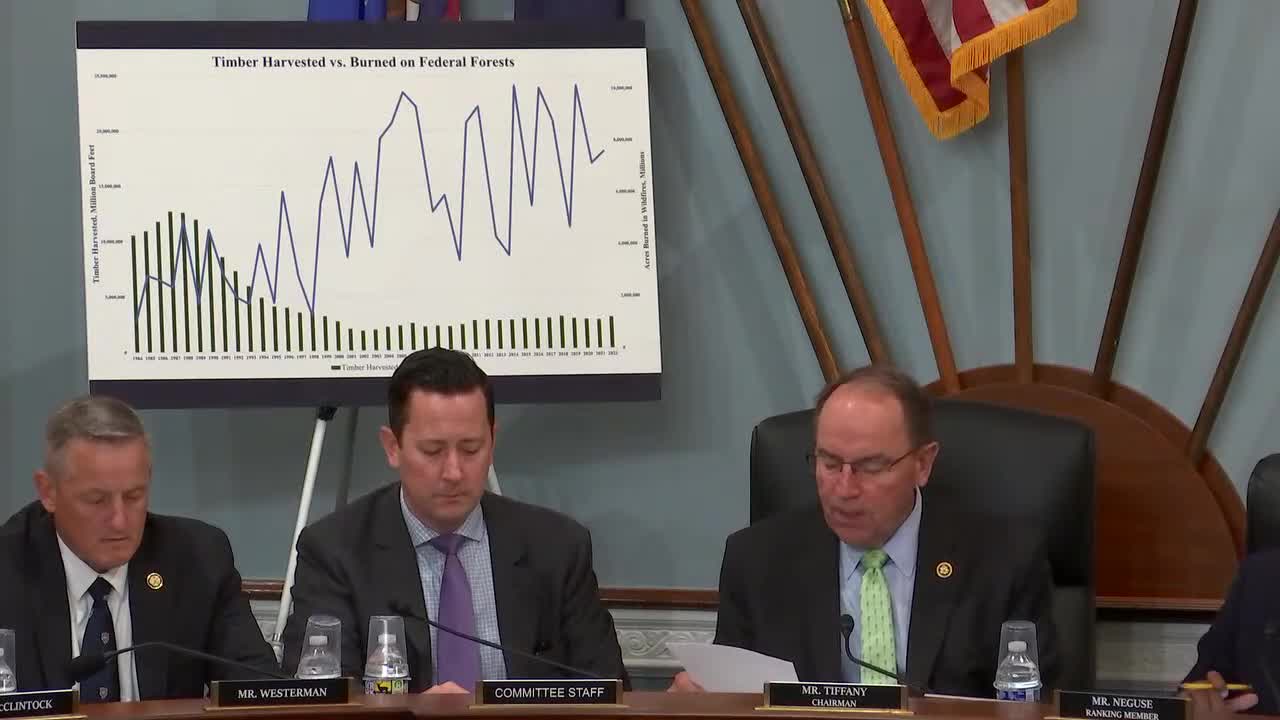
Summary
Lawmakers and U.S. Forest Service Chief Tom Schultz sparred at a House hearing over the Trump administration's push to rescind the 2001 roadless rule, increase timber production and speed environmental reviews as a way to reduce wildfire risk and revive rural mills.
At a House Natural Resources Subcommittee on Federal Lands hearing on Sept. 10, 2025, members questioned whether rescinding the 2001 roadless rule and expanding timber production will reduce wildfire risk and revive wood-product markets or instead open roadless and wilderness areas to greater development.
The issue mattered to both parties because it ties wildfire risk, local economies and longstanding environmental protections to competing remedies. Proponents said regulatory streamlining and longer timber-sale contracts will deliver supply certainty and private investment; critics warned that rolling back protections risks habitat loss and more logging in sensitive backcountry.
Chief Tom Schultz, the head of the U.S. Forest Service, told the panel that the administration is “taking decisive action” to address wildfire and forest-health problems left by earlier policy choices and pointed to a proposal to rescind the 2001 roadless rule. “The secretary further catalyzed positive change by proposing to repeal the 2001 roadless rule,” Schultz said, adding that local managers need more flexibility.
House Natural Resources Chairman Bruce Westerman said legislation such as the Fix Our Forest Act would “expedite environmental analysis, facilitate better state, tribal, and local collaboration, and advance new innovative wildfire technologies.” Westerman said the bill had passed the House and was moving in the Senate.
Rep. Tom McClintock argued that earlier legal and regulatory changes had sharply reduced federal timber outputs and weakened local mill capacity, saying, “An untended forest is no different than an untended garden.” McClintock cited the Tahoe Basin categorical exclusion as an example of faster reviews that proponents say allowed more treatment and helped protect communities during the Caldor Fire.
Opponents on the panel, including Rep. Joe Neguse and other Democrats, warned that rolling back the roadless rule and weakening NEPA protections could allow “clear cutting, road building and mining” in currently protected areas and that litigation and workforce constraints already limit the agency’s capacity. "The reckless move of doing that would open the floodgates of clear cutting, road building, and mining across some of the last intact undeveloped forest that we have left in this country," Neguse said.
Several members also pointed to litigation as a practical barrier to management. Schultz said litigation has a measurable impact on timber programs, noting that litigation has tied up hundreds of millions of board-feet in some regions and can make managers more risk-averse.
What comes next: lawmakers said they will continue to press the Forest Service on how changes would be implemented locally and how timber targets and new sale approaches (including longer contracts) would generate the certainty industry needs to invest in mills.
The subcommittee left the hearing record open for written questions; members were told to submit follow-up questions by Sept. 12, 2025.