
Contractors say embodied-carbon and EPD requirements could add substantial upfront costs
Get AI-powered insights, summaries, and transcripts
Subscribe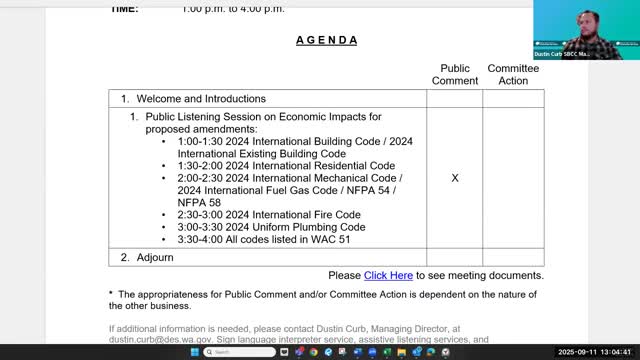
Summary
Tim Atterberry, with the Associated General Contractors of Washington, told the State Building Code Council work group that pilot projects implementing Environmental Product Declarations, or EPDs, generated substantial unbudgeted costs for contractors and project teams.
Tim Atterberry, with the Associated General Contractors of Washington, told the State Building Code Council work group that pilot projects implementing Environmental Product Declarations, or EPDs, generated substantial unbudgeted costs for contractors and project teams.
Atterberry said an email from Craig Holt, a former SBCC member who led a pilot EPD project at the University of Tacoma, showed that suppliers and fabricators billed tens of thousands of dollars for EPD work and that managing the process required weeks of staff time. “The project had to pay our mass timber supplier $35,000 and the steel fabricator $50,000,” Atterberry read from Holt’s email, and he added that the regulation “will consume roughly 60 to 70 staff hours to manage the process.”
The comments were made during a public listening session the council held to gather input on the economic impacts of proposed rule changes to the 2024 Washington State Building Codes. The SBCC is using feedback to determine whether “the probable benefits of the rules are greater than their probable costs,” the moderator said at the start of the meeting.
Atterberry also cited another contractor’s experience, saying Anderson Construction “found out there was $85,000 worth of costs that weren’t previously budgeted.” He recommended the council obtain detailed, project-level dollar figures and staffing models, including the University of Washington’s internal costs, to better assess compliance costs.
Atterberry criticized the underlying carbon accounting metrics used in some proposals, saying in part that “the contrived gauges of carbon footprint and global warming potential are arbitrary without peer review and damage any real effort to help the environment,” adding that tracking and reporting requirements nonetheless have real administrative and financial consequences.
The listening session moderator and SBCC staff invited written comments and directed stakeholders to the SBCC economic impact questionnaire and to submit comments to sbcc@des.wa.gov. No formal action or vote occurred during the session; the meeting consisted of oral comments and opportunities for written testimony.
SBCC staff will review the oral and written submissions as part of the rule‑making record for proposed changes to the building codes, including proposed provisions related to embodied carbon and product declarations.