
Casper presenters outline decades-long North Platte River restoration, seek major grants and construction funding
Get AI-powered insights, summaries, and transcripts
Subscribe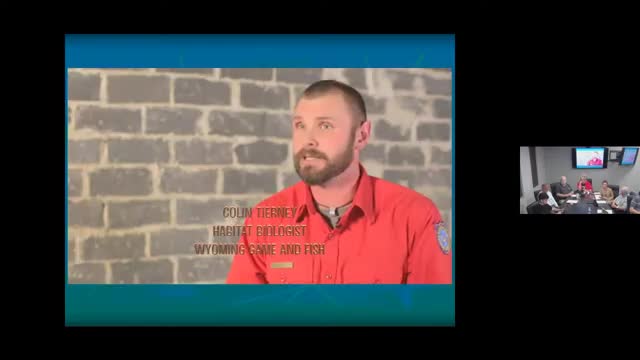
Summary
Casper city and partner staff on Sept. 9 updated the City Council on the North Platte River restoration project, a decades-long effort that project leaders said protects drinking water infrastructure, reduces erosion and supports recreation and tourism in and around Casper.
Casper city and partner staff on Sept. 9 updated the City Council on the North Platte River restoration project, a decades-long effort that project leaders said protects drinking water infrastructure, reduces erosion and supports recreation and tourism in and around Casper.
The presentation by Jolene Martinez, who has led the city’s restoration effort, and technical staff summarized completed work, ecological results and near-term funding and schedule: a $3 million WaterSmart grant will cover most of a $4 million Isaac Walton reach project; an $872,000 grant will fund design and study on the North Platte Park/Knife River reach and, if the study reaches 60% design and is approved, could qualify the city for a noncompetitive $20 million construction award toward a project with an estimated $30 million construction cost.
The project, Martinez said, “is an effort to improve one of our community’s greatest assets, the North Platte River.” She and other presenters described four broad goals: protect riparian wetlands and drinking-water wells, reduce sedimentation and bank erosion, restore fish and wildlife habitat and expand public access.
Presenters gave results from past work: volunteers have removed about 1,300,000 pounds of debris; volunteer days have drawn roughly 6,500 participants since 2007; Russian-olive removal has cleared multiple mature stands and allowed native cottonwood regeneration in places; the team estimates bank-erosion reductions equivalent to about 821 tons per year of sediment kept out of the river. Martinez said total project costs to date are about $10.6 million (2023 dollars), with roughly $2.3 million spent on land acquisition to protect riverfront parcels.
Technical staff described the Knife River/North Platte Park reach as the most complex remaining area. TC Dinkins, the project’s restoration engineer, summarized recent geomorphic studies and historical aerial analysis showing channel widening and changes tied to upstream reservoirs and historic gravel mining. “The river bed itself lowered and is now even more disconnected from this floodplain,” Dinkins said, describing a head-cut process that has contributed to the high erosion rates in the reach and to instability immediately downstream where banks are seven to eight feet tall.
Wyoming Game and Fish staff answered council questions about stormwater routed to constructed wetlands. John McCoy said wetlands “actually act as filters for contaminated water” and explained that vegetation and wet soils can trap and break down pollutants that would otherwise flow directly into the channel.
Speakers also described ecological and economic outcomes. Blake, a local fishing guide, said guide and angler spending supports hotels and restaurants; he estimated about 10,000 anglers a year and said customers report about $500 spent per angler per day. Wyoming Game and Fish staff said restoring habitat can increase invertebrate abundance and help trout reproduction in- town, lowering hatchery stock needs. Zach Hutchinson of Audubon Rockies told the council that improvements have supported nesting raptors including three nesting pairs of bald eagles through heavily used river reaches and have drawn birdwatchers to the region.
Project funding sources cited in the presentation included the Wyoming Wildlife and Natural Resources Trust (a $2 million grant previously awarded), state funding, city funds (including the one-cent sales tax), private donations and competitive federal grants such as Bureau of Reclamation WaterSmart awards. Martinez said, by percentage, about 46% of the project funding to date has come from the State of Wyoming, 30% from the city, 8% private and 6% from other governments and boards, with land acquisition comprising about $2.3 million of the total reported cost figure.
Councilors and presenters noted that Russian-olive removal and follow-up maintenance remain long-term tasks: volunteers and staff can clear seedlings quickly, but established stands require repeated treatment. Project staff described volunteer windows for Russian-olive work (late September through early December) and other invasive-species work (late May–early June for thistle control).
Martinez said a 30% design review for the Isaac Walton reach is scheduled for Sept. 18 and that construction on that reach is expected in 2026 if permitting and funding proceed as planned. The Knife River reach design and study funded by the $872,000 award will be used to compete for the larger $20 million construction award if design milestones are met.
The presentation closed with an invitation to the community: the annual Platte River Revival volunteer day was announced for Saturday, Sept. 27, and project leaders encouraged continued volunteer participation for maintenance and invasive-species removal.