
Longmont council weighs ‘sit-and-lie’ ordinance after months of outreach; no final adoption at meeting
Get AI-powered insights, summaries, and transcripts
Subscribe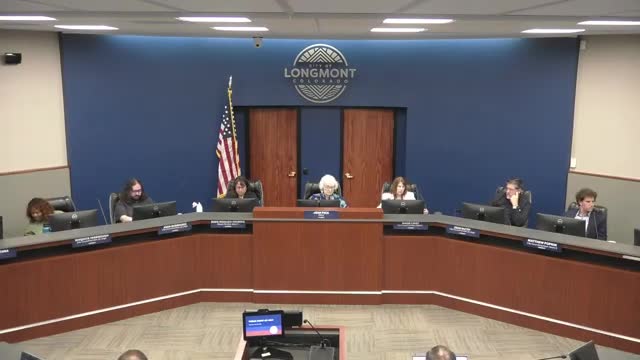
Summary
Longmont City Council members on Sept. 9 considered an ordinance (Title 10, section 10.24.130) that would restrict sitting or lying in designated commercial right-of-way areas and reviewed a staff plan pairing outreach with limited enforcement, but did not adopt the proposal at the meeting.
Longmont City Council members on Sept. 9 considered an ordinance (Title 10, section 10.24.130) that would restrict sitting, lying, kneeling or reclining in specified commercial right-of-way areas and considered a staff plan pairing outreach with limited enforcement. The council opened extensive discussion after a public-safety presentation and public comments from nonprofit leaders and residents.
The ordinance would apply only to certain designated commercial areas and would require officers to ask people to move before any enforcement action. Zach Artis, Public Safety Chief for the City of Longmont, said the city’s proposal is narrower than a Colorado Department of Transportation (CDOT) affidavit he described, and that the proposed city ordinance focuses on conduct in limited geographic areas identified from calls for service. “By contrast, the city ordinance applies only to limited areas and only to specific geographical areas and restricts individuals from sitting, lying, kneeling, reclining in those areas,” Artis said.
Why it matters: Councilors and staff said the proposal is one small tool aimed at improving safety and addressing persistent calls for service in commercial corridors; nonprofit leaders and unhoused advocates warned it could displace people and increase burdens on shelters and service providers. The discussion included operational details about paired outreach by HOPE and LEAD case managers and what enforcement would look like if the ordinance were adopted.
What staff proposed and the outreach plan
Public Safety Chief Zach Artis and Emily Van Dorn, program manager for LEAD and co-responder teams, described a phased approach combining outreach and voluntary compliance with limited enforcement as a last resort. Artis said CDOT has offered to sign trespass affidavits for CDOT-owned right-of-way outside city limits; the city’s measure, he said, is narrower and focused on specific business corridors.
Van Dorn summarized a months-long collaboration between Public Safety and HOPE that included pilot responses pairing a HOPE outreach worker, a public-safety peer case manager and a law enforcement partner in a non-enforcement capacity. She described a proposed operational change in which case-management staff begin outreach earlier in the day, and two weekdays include a non-enforcement law-enforcement partner to improve engagement and reduce calls for service during peak times.
Public comment and nonprofit concerns
Multiple nonprofit leaders and service providers urged the council to prioritize services and to avoid criminalizing people who are unhoused. Alice Seltonfuss, executive director of HOPE (Homeless Outreach Providing Encouragement), said a joint intervention plan between public safety and HOPE “looked good” but warned the ordinance would disproportionately affect people without shelter and noted there is currently “no sanctioned place in Longmont for unhoused people to go during the day.”
Jen Jepsen, director of Recovery Cafe Longmont, said the cafe is a recovery-based drop-in program and “we are not a day shelter,” and warned that listing recovery programs as places to move people could be short-sighted. Nia Woznick, a resident and community advocate, cited national studies she said show sit-and-lie ordinances often do not reduce business calls for service and can impose higher enforcement costs.
Council questions and legal framing
Councilors pressed staff on resource and enforcement implications, diversion options, and whether the city had capacity to sustain the proposed outreach. Mayor Pro Tem Hidalgo Faring asked whether the city had enough staff and whether enforcement would increase officer time in affected locations; Artis and Van Dorn said much of the city’s current workload already addresses these calls and that the proposed model aims to resolve many contacts before law enforcement is notified.
Eugene May, City Attorney, explained that staff structured the ordinance to provide a remedy of last resort and said the affirmative-defense language was modeled on existing code sections; council members discussed alternatives and whether affirmative defense language should remain.
Council action and procedural outcome
Council member Christ moved to adopt the ordinance as drafted (bill for an ordinance amending Title 10, Longmont Municipal Code, section 10.24.130). The initial vote did not result in adoption. Council later voted to reconsider the failed vote (motion to reconsider carried 5–2), and members debated multiple proposed amendments (including changes to the affirmative‑defense language, inclusion of ride‑share waiting as an exception, and varying longer implementation/education periods). Several proposed amendments failed for lack of agreement; multiple subsequent attempts to adopt the ordinance with different implementation timelines (including 45‑day and proposed 90‑day education periods) also failed to secure council approval during the Sept. 9 meeting.
No final adoption occurred at the Sept. 9 meeting. Council directed additional outreach, asked staff to continue evaluating operational details (including diversion and court alternatives), and signaled interest in returning to the item after more community engagement and further refinement of enforcement and court‑diversion processes.
Ending note
Artis emphasized that the ordinance is “a limited tool focused on conduct in the public right of way” and not a solution to homelessness; he reiterated the city’s multi‑million‑dollar investments and continued reliance on outreach and services as the primary path to long‑term solutions. Council members asked staff to return with additional implementation detail, resource estimates and updated engagement results before any renewed adoption effort.