
Longmont council rejects sit-and-lie ordinance after weeks of outreach planning
Get AI-powered insights, summaries, and transcripts
Subscribe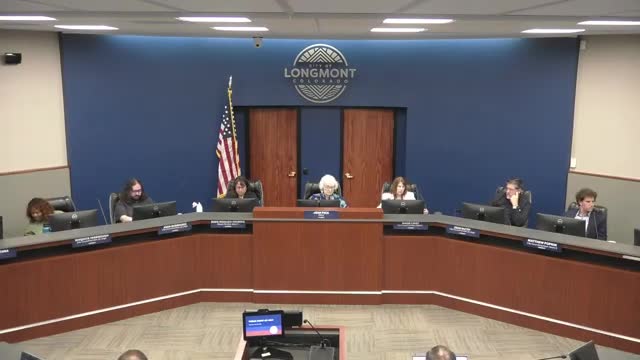
Summary
The Longmont City Council voted down a proposed ordinance (Title 10.24.130) that would have restricted sitting or lying in designated commercial right-of-way areas, after lengthy discussion about enforcement, nonprofit capacity and a new outreach plan from public safety and HOPE.
The Longmont City Council on Sept. 9 rejected a proposed ordinance amending Title 10 of the Longmont Municipal Code (Section 10.24.130) that would have prohibited sitting, lying, kneeling or reclining in specified commercial right-of-way areas. Councilor Susan Christ moved to adopt the ordinance; the motion failed 3–4. Four council members were recorded as opposing the measure.
Council members and city staff spent more than an hour discussing the ordinance, which public safety said was intended as a narrow tool for specific locations with repeated calls for service from businesses, not a general solution to homelessness. Public Safety Chief Zack Artis said the city had recorded roughly 450 calls for service related to unhoused individuals in a six-month period and that most contacts did not result in enforcement. Artis said CDOT (the Colorado Department of Transportation) has a broader affidavit and signage option that could prohibit presence on CDOT-owned right-of-way; the city measure was narrower in scope.
The proposal prompted testimony from nonprofit partners and residents at the meeting and in earlier stakeholder sessions. Emily Van Dorn, program manager for the city—s LEAD and CORE teams, described a months-long collaboration with HOPE (Homeless Outreach Providing Encouragement) to develop a blended, service-first response that pairs outreach workers with public safety case managers and occasional non-enforcement law-enforcement partners. Van Dorn summarized the approach as "pairing accountability with compassion through outreach, case management, and collaboration," and said the teams had tested paired responses and planned adjusted schedules to proactively engage people during the morning hours when many calls were created.
HOPE executive director Alice Seltonfuss described the collaborative plan and warned that moving people from private property to parks or other public spaces without additional resources could create new problems. Recovery Cafe Longmont Director Jen Jepsen and other nonprofit leaders told council the city should avoid solutions that rely on nonprofits to absorb substantial new operational burdens. Jepsen said her organization is "not a day shelter" and that listing recovery programs as a default option for people who are unsheltered was "short-sighted."
Council debate focused on resource capacity and downstream effects: whether enforcement would simply displace people elsewhere in the city, whether case managers and nonprofit partners have capacity to absorb increased needs, and how the municipal court and diversion options would be used if citations were issued. Van Dorn and Artis said the city would use a phased education period before enforcement, expand outreach shifts to five days a week with paired staff two days per week, and evaluate results using call-for-service data and partner feedback. Artis said "outreach and voluntary compliance has failed" in the narrow set of repeat-problem locations but emphasized the city—s broader investment in services, noting the city committed nearly $1.5 million to homeless services in 2025.
After debate, the council vote failed. No formal ordinance was enacted. Councilors and staff agreed to continue cross-sector collaboration and to bring further information to council in future budget and operations briefings.
Why this matters: business owners in some commercial areas reported repeated, time-consuming calls for service tied to people remaining in right-of-way areas; public safety said officers frequently spend time determining whether a person is on private property or on the public right-of-way. Nonprofit leaders said enforcement without concurrent capacity-building risks hurting the people the city intends to help and asked that the city avoid simply shifting problems to other locations.
The City Manager and public safety staff said they will continue the outreach partnership with HOPE, LEAD and community partners and will track calls for service and case-management outcomes as the collaborative approach continues.