
Charlottesville staff propose ordinance changes to give oversight office operational authority
Get AI-powered insights, summaries, and transcripts
Subscribe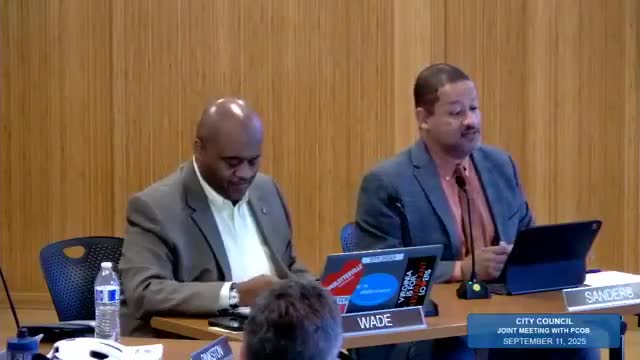
Summary
City staff presented a redline of the Police Civilian Oversight Board ordinance that would create a formal Office of Police Civilian Oversight, make the director a city position reporting to the city manager, and let the office carry out audits and routine oversight work when the board lacks a quorum.
Charlottesville city staff on Sept. 11 presented a package of revisions to the Police Civilian Oversight Board ordinance that would establish an Office of Police Civilian Oversight, rename the executive director position as director and give the director authority to perform oversight activities on behalf of the board when the board cannot convene a quorum.
The proposed changes were introduced by James Walker, acting executive director for the Police Civilian Oversight Board. “This is really the meat of indicating, hey. The director can carry out these duties independent of the board, but can also be directed by a majority vote of the board,” Walker said as he explained additions that move operational duties into a codified office and align the role with other city departments.
City staff said the intent is to preserve the board’s powers while ensuring the office can continue investigations, audits and other oversight work even when the PCOB lacks the membership to vote. Walker identified specific examples of current office work — reviewing department systems such as the automatic license-plate reader system, attending CompStat and other department meetings, reviewing department policies, participating on officer interview panels and serving on use-of-force review panels — and said the redline puts those routine practices into ordinance language so they are reported back to the board.
The nut graf: the revisions would not remove any powers from the board, staff said; instead they would formalize the existing practice that the director performs operational oversight activities and would delegate the technical approval of a long, complex set of operating procedures to the city manager rather than require a separate city council vote each time the procedures are revised.
Key provisions presented included: moving the executive-director section to the front of the ordinance and renaming the role as director; creating an explicit “office established” subsection based on the Office of Human Rights ordinance; clarifying that access to police records and systems is administered through the director’s office; elevating rules on subpoenas and the conduct of investigations to standalone sections; removing redundant or internally inconsistent language; and consolidating community engagement and reporting requirements. Walker said operating procedures are large (he described them as roughly 80 pages) and contain internal conflicts that make routine technical edits difficult if each change must be voted by council.
The presentation also proposed narrower changes to disciplinary language, striking text that recommended the board consult supervisors on binding disciplinary decisions and removing a requirement that the board take testimony from witnesses to recommend discipline. Staff said that language was inconsistent with state law and with the department’s existing disciplinary matrix, because binding discipline is imposed by the police chief under existing general orders.
On access to data, the redline clarifies the director’s current ability to log in to systems such as Axon (body-worn camera) and Flock (license-plate reader) and to compile condensed investigative packets for board review rather than requiring board members individually to watch large volumes of footage. Walker said that practice — where staff pulls salient clips and creates a condensed packet for volunteers — is already described in operating procedures and the ordinance revision makes the practice explicit.
Staff also recommended striking or recodifying passages that duplicated other code sections, moving an “objectivity” statement near membership provisions, and removing requirements that had not been met in practice, such as the current mandate for two community listening sessions per year. On training, staff proposed replacing an 8-hour, council-specified mandatory training delivered by an external contractor with more-flexible training options that the director could provide using national materials and modular content.
Acting Chair Jeff Frasier opened the presentation by saying the revisions aim to “get this body to wherever it needs to be to be able to function.” Frasier also told the public, “I will dispel any myths and rumors about ending the PCOB that is not have has not been discussed, that is not a part of the conversation.”
No ordinance vote occurred at the meeting; staff presented the redline for discussion and said specific items that require council action would be returned in future meetings. Council and board members asked for a clean copy of the draft and additional time to review the proposed text alongside operating procedures.
Ending: staff said these edits are primarily operational—intended to align titles, clarify information access, and allow the office to keep working when the volunteer board lacks quorum. The city manager and staff signaled further ordinance and policy work would follow and that they will post a clean version of the redline for public review.