
Staff proposes ordinance rewrite to let Charlottesville oversight office operate without full board
Get AI-powered insights, summaries, and transcripts
Subscribe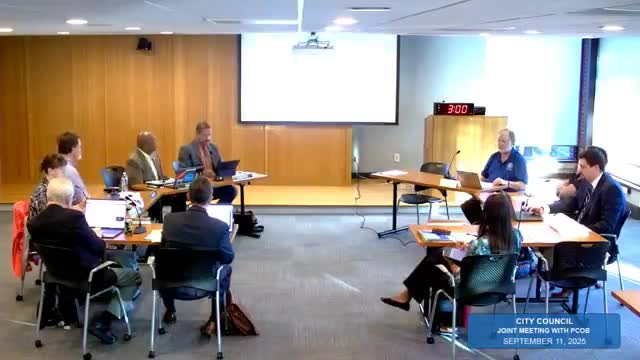
Summary
City staff presented detailed edits to the Police Civilian Oversight Board ordinance aimed at creating a formal Office of Police Civilian Oversight, giving its director clearer authority to act on behalf of the board, and streamlining procedures for information access, audits, investigations and training.
CHARLOTTESVILLE, Va. — Charlottesville staff presented a redlined rewrite of the police civilian oversight ordinance at a Sept. 11 joint meeting of the City Council and the Police Civilian Oversight Board, proposing to formally establish an Office of Police Civilian Oversight and to give the office's director greater operational authority to act on the board’s behalf when the board cannot vote. The presentation was led by James Walker, acting executive director for the oversight office.
City staff said the package focuses on the office’s operations: renaming the position “director” to match city practice, moving director duties to the front of the ordinance, clarifying who administers access to department records and giving the director explicit authority to carry out audits, investigations and other oversight activities even when the board lacks a quorum.
The revisions aim to reduce procedural barriers that staff said have stopped the office from functioning in practice. “The goal is to clean up some of the language, the wording that restricts the office from carrying forward actions,” James Walker said during the presentation. Walker said many of the proposed changes mirror language used in the city’s Office of Human Rights ordinance.
Under the draft, the governing body would still retain ultimate authority but would delegate detailed approval of the office’s operating procedures to the city manager to streamline review. Walker said operating procedures amount to an “80‑page document” with internal inconsistencies that make council-level approval unwieldy. The proposed change would keep the City Council’s oversight role while authorizing the city manager to approve the procedures that control day‑to‑day operation.
The draft also recodifies multiple sections and relocates material for clarity. Key operational changes in the staff package include: - Director authority: The director would be authorized to conduct non‑financial audits of department systems and practices (Walker cited the Flock automated license‑plate reader system and Axon body‑camera footage as examples) and to attend internal meetings such as CompStat and officer interview panels; the board could still direct audits by majority vote when it is able. - Information access and confidentiality: The ordinance would explicitly state that access to department records is administered by the director and would add the director to confidentiality obligations that previously mentioned only board members. - Investigations and subpoenas: Staff recommended elevating subpoenas and the conduct‑of‑investigations rules into distinct sections and removing repetitive language that implied the director must always work “with the department,” to reflect current practice of direct access to Axon and other systems. - Hearings and operating procedures: Hearings would be governed by the operating procedures; staff proposed moving and consolidating hearing language to reduce redundancy in the ordinance. - Discipline recommendations: Staff proposed striking language that asked the board to consult supervisors, complainants and witnesses when recommending discipline, saying the board has no binding disciplinary authority and that discipline matrices and grievance rights are governed by CPD policy and the collective bargaining agreement. - Training and community engagement: The draft reduces prescriptive training requirements (the ordinance previously required eight hours within 90 days) and removes a strict mandate for two town halls/listening sessions per year, replacing those provisions with more flexible language that allows the director and the board to tailor community engagement and training approaches (including online modules, ride‑alongs and the Citizens Police Academy). - Legal counsel procurement: Staff recommended changing the procurement practice so that the director (as part of city administration) would handle contracting outside counsel rather than volunteer members of the board, to align with Virginia procurement law and avoid potential conflicts.
Walker and other presenters emphasized the edits are intended to enable existing practice, not to expand the board’s statutory powers. “It is not attempting to take away anything, but just to go ahead and put those positions and that office in parallel to all the others that exist today,” Walker said.
Council and board members asked detailed clarifying questions throughout the presentation about where language was being moved, whether new text had been added, and how the proposed changes would interact with existing city and police policies. Councilor discussion focused on clarity of code citations, whether some sentences require added punctuation for readability and whether certain sections should be presented as a clean copy for public review. Walker said this redlined package is one of several prior drafts and promised to provide a consolidated clean version.
Staff repeatedly framed the changes as operational: enabling the director and office to perform oversight tasks (reviews, audits, policy reviews, panel participation) even when the volunteer board cannot convene a quorum. According to Walker and the acting board chair, those constraints have slowed the office’s ability to deliver timely oversight and to present condensed evidence packets (including pulled highlights of body‑camera footage) for board consideration.
Discussion also touched on procurement and outside counsel costs. Walker said an RFI for outside counsel had been circulated but observed that outside attorney fees quoted in the past had been “prohibitive” and that the office had exhausted funds in prior years. Staff told the joint meeting the city attorney’s office could supply a recommended list of outside attorneys but noted selecting counsel raises procurement and conflict‑of‑interest questions.
The staff presentation closed with next steps: staff will post a clean copy of the ordinance for public transparency, continue refinement with the city attorney’s office, and return the recommended ordinance and associated operating procedures to council for further review and potential action.
Ending: Staff emphasized these proposed edits are a targeted, operational first pass and that larger structural changes and additional substantive items remain for future meetings. Walker and the acting chair said they will continue meeting with council and stakeholders and that staff will post a clean copy and return with refined proposals.