
Board approves opioid settlement implementation plan, transfers funds to behavioral health
Get AI-powered insights, summaries, and transcripts
Subscribe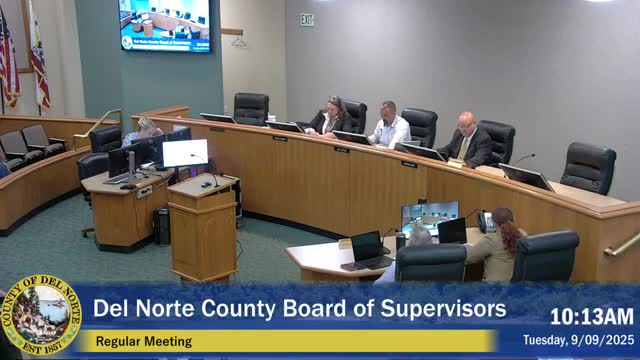
Summary
Del Norte County supervisors approved an implementation plan from the Opioid Settlement Work Group to spend prescription-opioid settlement money on prevention, treatment, recovery supports and related infrastructure, and they transferred the settlement funds into the Behavioral Health budget.
The Del Norte County Board of Supervisors on a unanimous vote approved an implementation plan for the county's portion of opioid settlement funds and directed Behavioral Health to manage the funds and meet the settlement reporting requirements.
The action approves the Opioid Settlement Work Group's recommendation, transfers the settlement account into the Department of Health and Human Services, Behavioral Health budget, and directs the behavioral health branch to comply with reporting and the approved implementation plan.
The plan presented by Cheyenne Hogan, Deputy Director for Behavioral Health, and Germaine Brubaker, facilitator of Rx Safe Del Norte, allocates the funds into four primary categories: a dedicated coordinator position to manage stakeholders and planning; expanded treatment capacity (local, out-of-county and in-custody); operating costs for stakeholder engagement, outreach and low-barrier services; and training/support plus some infrastructure set-aside to leverage longer-term behavioral health infrastructure funds. Hogan told the board the work group expects to receive about $1,500,000 by the end of the current fiscal year and conservatively projected roughly $4,000,000 in settlement receipts over future years (the presentation did not specify the date range for that projection).
The presenters said state and settlement rules constrain uses. As noted in the work-group presentation, California law and settlement guidance require that a substantial portion of funds be dedicated to abatement activities; the presenters cited that at least 50% of funds should be used for high-abatement activities as defined by the state Department of Health Care Services. The written implementation plan submitted to the board spells out allowable activities and ties proposed uses to settlement reporting requirements.
Supporters and some board members framed the plan as building local capacity. "We're trying to stall because we're getting towards winter, and time is of the essence," said Tony (county staff), describing an urgency to begin work so services can ramp before seasonal demand. Board members moved and seconded the item and voted yes (Supervisor Starkey, Supervisor Short and Chair Borges) to approve the recommendation and transfer the funds.
Public speakers urged a mix of prevention and enforcement approaches. Alicia Williams (public commenter) said the plan emphasizes treatment and urged more focus on prevention, including reducing prescription rates by medical providers and reestablishing a drug task force. Other members of the public urged expansion of prevention in schools, provider education, community drug disposal, and first-responder diversion programs — points the presenters said are allowable under the settlement’s prevention and abatement categories.
The motion directs Behavioral Health to implement the approved plan and to comply with all settlement reporting conditions. The board also approved on the consent agenda a proclamation designating September 2025 as Recovery Awareness Month, which the board read into the record and adopted; the proclamation recognizes local behavioral health work and urges community support for prevention, treatment and recovery services.
The implementation plan and the county report to the board note next steps: staff will begin contracting or hiring for the coordinator role, pursue partnerships to expand low-barrier services and medication-assisted treatment access, and prepare the state-required reports tied to settlement disbursements. Hogan and Brubaker said more detailed budgeting and program documents are included in the written plan and will be updated as additional settlement dollars arrive.
Questions and next steps raised by supervisors included where the money will be held (now transferred into Behavioral Health’s budget), whether individual program costs would be adjusted as more money arrives, and how progress will be measured. The board’s approval establishes the implementation framework and the administrative direction to Behavioral Health to proceed under the terms presented.
Evidence spans from the meeting transcript: item introduction, the work-group presentation, public comments urging prevention and drug-task-force options, and the motion, second and roll-call vote to approve the plan.