
OSTP frames AI plan as tied to manufacturing jobs, workforce training and biotech research
Get AI-powered insights, summaries, and transcripts
Subscribe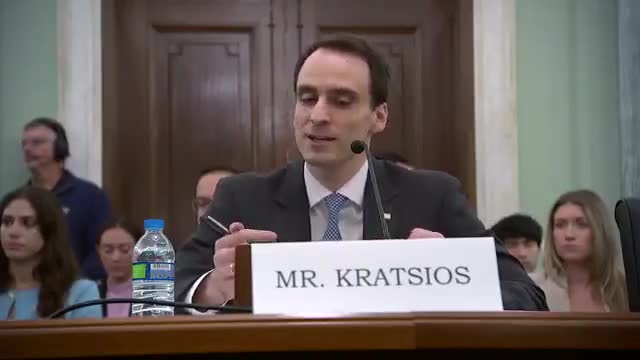
Summary
OSTP Director Michael Kratios told senators the AI Action Plan includes workforce development, reskilling, and collaboration with Manufacturing USA and NIMBL‑type cloud‑lab proposals to accelerate biotech research; he described opportunities for apprenticeships, training programs and automated cloud labs.
At the Sept. 17 hearing, White House OSTP Director Michael Kratios described components of the AI Action Plan intended to support manufacturing, workforce development and biotechnology research.
Kratios said pillar two of the plan emphasizes infrastructure and the jobs that will be created by data center and chip manufacturing build‑outs. "A lot of the effort around pillar 2 is about the retraining, the reskilling, and the preparation of the trades that will ultimately support the necessary build out of all the infrastructure for this," he said. Kratios noted OSTP will work with Commerce, Manufacturing USA programs and the Departments of Labor and Education on training and apprenticeship programs.
Senators representing manufacturing and biotech hubs asked about use cases. Senator Young, who chairs the National Security Commission on Emerging Biotech, described proposed legislation to create a national network of cloud labs for automated biological research; Kratios said automated cloud labs could accelerate the pace of discovery when coupled with AI that designs experiment iterations. "If you layer on top of that the power of artificial intelligence... the pace and the velocity of discovery will be dramatically improved," Kratios told the committee.
Senator Blunt Rochester raised biosecurity concerns and asked how OSTP would engage institutions such as the National Institute for Innovation in Manufacturing Biopharmaceuticals (NIMBL/NIMBLE). Kratios acknowledged biosecurity is important and said the administration has capacity across agencies to perform testing and evaluation and to leverage AI for breakthroughs in biosciences while noting the need for safeguards.
Kratios and senators emphasized apprenticeships and K–12 education, including an OSTP‑led AI Education Task Force chaired by the first lady. Kratios said the administration supports apprenticeship expansion and programs to reskill workers for jobs supporting AI infrastructure and manufacturing.