
Fargo Public Schools outlines $3.5 million annual utility spend, plans upgrades after facilities assessment
Get AI-powered insights, summaries, and transcripts
Subscribe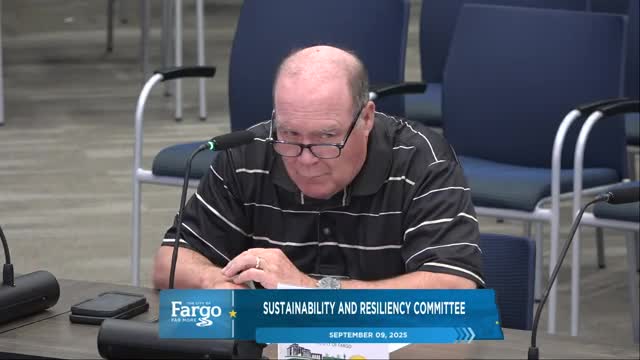
Summary
James Hand, director of facilities for Fargo Public Schools, told the Sustainability and Resiliency Committee that a 2023 facilities condition assessment found the district spends about $2,800,000 on electricity and about $860,000 on natural gas annually across almost 3,000,000 square feet in 27 buildings.
James Hand, director of facilities for Fargo Public Schools, told the Sustainability and Resiliency Committee that a 2023 facilities condition assessment found the district spends about $2,800,000 on electricity and about $860,000 on natural gas annually across almost 3,000,000 square feet in 27 buildings. "We were spending about $2,800,000 on electricity and $860,000 on gas, totaling about 3 and a half million dollars in annual utility expenses across the district," Hand said. He said the assessment included a preliminary energy audit to identify opportunities to improve indoor air quality, reduce disruptions from equipment failures, lower operating costs and shrink the district's carbon footprint.
The district’s assessment produced a long list of recommended actions ranging from LED lighting retrofits and athletic/parking‑lot lighting upgrades to plumbing retrofits, smart irrigation controls, envelope weatherization, building automation upgrades, demand‑controlled ventilation and duct sealing. Hand said the district has already begun updates to building automation systems and is continuing LED conversions where feasible, leveraging state and federal grants when available.
Hand described how the district tracks recommended work: a computerized maintenance and asset management system that currently holds roughly 6,000 line items from the facility condition assessment, each with an action year and prioritization criteria. He said priorities are first to avoid unplanned disruptions and to address safety hazards, with energy performance a primary secondary consideration. "If the boiler goes out in the middle of winter, that's a big bummer," Hand said, describing the district’s operational priorities.
Hand also described the district’s energy design process and the sustainability vision developed by a group including board members, community members, facilities staff, teachers and representatives from Xcel Energy and Cass County Electric. He said the district’s stated priorities when making design choices are: occupant health and wellness first, then energy efficiency and building life cycle. "Our buildings will do everything we can to keep the temperature between 68 and 72 degrees," he said, describing the district standard of comfort used in scheduling and control updates.
On specific technologies, Hand said several district buildings use geothermal systems — Davies, Discovery, Bennett and Kennedy — which show lower energy use per square foot. But he cautioned that geothermal systems carry higher maintenance and replacement costs than some conventional systems: "The one thing that is not represented there is the maintenance cost, which is a consideration with geothermal as well." He said the district will evaluate geothermal again during design for a planned replacement school project starting design the day after this meeting, but that site constraints and life‑cycle cost analysis will factor into the decision.
Hand said the district installed ultraviolet (UV) germicidal equipment in almost all school HVAC systems during the COVID period, using ESSER funding, and that the district now includes that equipment in its standards. "We do and we do have that built into our standard now because we believe it works pretty effectively," he said. He noted, however, that particle filtration and air‑quality sensors are not uniformly deployed across all buildings and that sensor accuracy varies.
Committee members asked about the district's computerized maintenance management system and whether students could have ongoing roles in energy/sustainability advisory work. Hand confirmed the district uses an asset management module to store asset data, replacement schedules and O&M manuals and said he would welcome student involvement when practical. Several committee members praised the district’s emphasis on life‑cycle cost analysis and durability standards.
No formal committee action on district projects or funding was taken during the meeting; Hand's presentation was informational. The committee will next meet Dec. 9 to wrap up its year.