
Santaquin planning commission forwards water-use, conservation amendment to City Council
Get AI-powered insights, summaries, and transcripts
Subscribe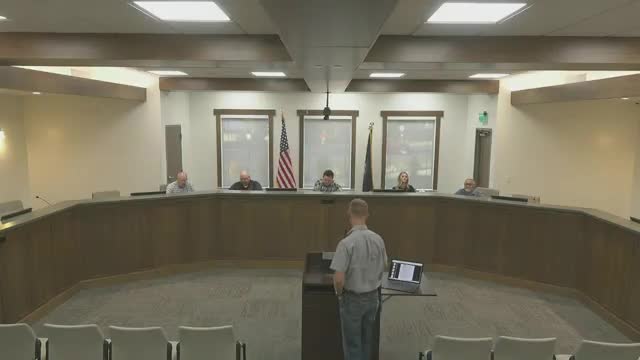
Summary
The Santaquin City Planning Commission voted unanimously Sept. 9 to forward a recommended general-plan amendment adding a water use and conservation element to the City Council, with amended language about rate structure and turf definitions.
The Santaquin City Planning Commission on Sept. 9 voted unanimously to forward a positive recommendation to the City Council for a proposed amendment to the city’s general plan that would add a water use and conservation element. The commission approved the recommendation after adding clarifying language on how rates would be structured and on the definition of “turf.”
The amendment responds to a 2022 state legislative requirement that municipalities above certain sizes add a water-use and conservation element to their general plans. Planning staff presented a draft prepared in coordination with a water-modeling consultant and said the draft largely reflects existing city practices. "This is a draft," the presenter said, describing historical use data back to 2013 and a recent spike in recorded irrigation use after the city replaced old pressurized-irrigation meters.
Why it matters: the element will guide the city’s approach to conserving water as Santaquin grows, identify existing water sources and capacity, and spell out potential conservation policies and incentives that could affect residents, homeowners associations and developers.
Most important facts: commissioners approved an amended motion to forward the document to the council. The amendment asked staff to reword the draft so it clarifies the interplay of base charges and usage rates (rather than relying on lot-size alone) when considering allocation-based, tiered pricing, and to replace the draft’s generic use of the word “turf” with language specifying live sod/real turf (not artificial turf) unless the council elects otherwise. The planning commission’s vote was recorded as unanimous.
Staff described Santaquin’s water supplies and constraints. According to the presentation, culinary water currently draws on multiple sources in active service: three wells and a spring emerging from Santaquin Canyon; wells are used to supplement the spring during summer. Pressurized irrigation uses a mix of sources, including agreements with the Summit Creek Irrigation Company, a city well, and treated effluent from the city’s water-reclamation facility. The presenter also said the city will begin receiving delivery from the Utah Lake System pipeline next year and that "we get just a little over 900 acre-feet" from that pipeline, which staff said would help address some of the city’s projected shortfall.
Commissioners and staff discussed specific conservation measures that appear in the draft, including: historical water-use graphs; the recent meter-replacement grant that raised measured PI (pressurized irrigation) consumption figures; building-code measures such as low-flow fixtures; rebate programs referenced in the draft tied to the Central Utah Water District; and landscaping approaches (trees and rock/gravel planter strips) that reduce irrigation demand. Staff noted a typical detached home in the city uses on the order of two-thirds of an acre-foot of water and that irrigating turf is commonly modeled at about 4 acre-feet per acre; both figures were offered by staff as context for planning calculations.
There was particular discussion of allocation-based, tiered pricing: staff had included that model as one option, with an example referencing other Utah cities. Several commissioners expressed concern with any model that charged higher rates solely on lot size rather than on measured use or on meter capacity; staff agreed to revise wording to make the draft’s intent and options clearer. Commissioners suggested that if differentiated base charges are needed, meter size (which reflects service capacity) is a more common and defensible basis than pure lot area.
Formal action: Commissioner Hoffman made the initial motion to recommend the amendment to the council; Commissioners Romero and others seconded and discussed amendments. Commissioner Nixon offered the amendment to require the clarified language on rate structure and to change the word “turf” to refer to real sod/live turf rather than artificial turf; that amendment was seconded and carried. The commission recorded affirmative votes from Commissioners Waite, Hoffman, Wood, Nixon, Romero and Mook; the recommendation will be forwarded to the City Council.
Discussion vs. decision: the commission’s action was a recommendation to the City Council (a formal referral); staff were not directed to adopt new policies at the meeting. Several policy options and clarifications were discussed but no pricing policy or ordinance was adopted at this hearing.
Next steps: the document will be transmitted to the City Council for its review and potential adoption; staff said additional refinements and redlines requested by commissioners would be incorporated before the Council review.